Local ordinances aim to protect wildlife
Anacortes bans feeding deer, raccoons, pigeons, seagulls; San Juan County considering similar law.


By Richard Arlin Walker, Salish Current
Life is precarious for wild animals living close to roads in Anacortes and on San Juan Island.
Some 59 deer have been struck by motor vehicles in Anacortes since January 2024, according to the Anacortes Police Department. Thirty-three of those deer died instantly or were mortally injured and put out of their misery with a law enforcement officer’s gun.
Several foxes have been struck by vehicles at San Juan Island’s Cattle Point while crossing the road in search of a handout. This month, social media pages had posted photos showing foxes approaching parked cars for food. “Flattered humans stop in the middle of the road to feed and photograph them and the cycle repeats itself,” local photographer Fred Horn wrote. “It’s early spring and this is what happened this evening—can’t imagine what it will be like when the crowds come.”
Changes are coming.
Wildlife advocates and representatives of state and local agencies have drafted an ordinance that would make it illegal to feed foxes—as well as deer, raccoons and otters—in San Juan County. The ordinance would also require people to keep 25 yards from foxes et al. Violators ticketed by a sheriff’s deputy would face a $250 fine. A follow-up to the May 12 public hearing is scheduled for June 9.
The Anacortes City Council unanimously approved a wildlife protection ordinance in April that makes it illegal to feed deer—as well as raccoons, seagulls and pigeons—within the city limits. First-time violators face a $25 fine, increasing to $50 for each subsequent violation. The city also installed digital radar speed signs and increased police patrols on 12th Street and Oakes Avenue to get motorists to slow down. Deer graze along the roadway, which is heavily trafficked by vehicles going to and from Washington Park, the state ferry landing and neighborhoods along the way.
The ordinances do not apply to bird feeders or vegetation.
Anacortes has a population of roughly 18,000, double what it was in 1980. Neighborhoods emerged on lands where deer once grazed, forcing an uneasy residency between people and ruminants.
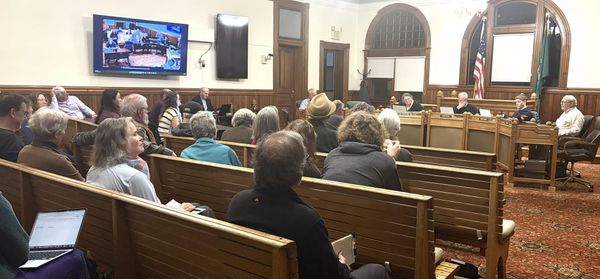
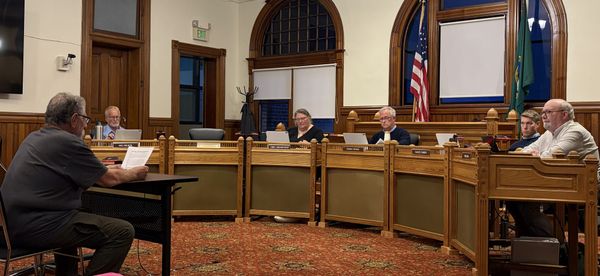
No one spoke in opposition to the ordinance at city council meetings, and there were no letters of opposition included in council packets as public comment.
City Councilmember Carolyn Moulton said she received an email from a constituent who thought that the ordinance would ban bird feeders, “but was assured that it does not.”
Six letters of support, however, were included in council packets as public comment, the senders having copied the letters to the city clerk or the entire council.
The writers said deer congregate in areas where there are handouts, making them more susceptible to disease and being struck by vehicles. Food left for deer that is not eaten by them can attract rodents.
Gulls, too, congregate where the food is. Anacortes Mayor Ryan Walters said gulls nest on top of city hall, located near downtown and the waterfront where dumpsters and outdoor dining can often yield a snack. And the seabirds leave a mess.
“Generally, we’ve spent $70,000 or so over the last two years to abate seagull nesting on city hall, where the buildup of seagull droppings was so significant that it was making staff who sat near windows sick to smell all that,” Walters said. The city uses a trained falcon to harass seagulls so they don’t nest atop city hall.
“Now, we’re always going to have seagulls and we’re always going to have deer, but what we’re trying to avoid is the concentration of them as a result of the artificial condition of them being fed by people,” Walters said.
Amelia and Brent Kolb wrote to the city council that the ordinance was overdue. They said feeding attracts deer that take detours through their yard, “(eating) nearly everything we plant in our yard that does not have a fence around it, including deer resistant and toxic plants such as rhubarb, mint and ferns.”
Corn left for the deer by neighbors “causes the deer to produce unnaturally large, wet feces piles in our yard. The corn also attracts large flocks of pigeons that then roost over and make a mess of our and our neighbors’ vehicles and sidewalk.”
Kolb added, “Concentrating them immediately next to our busy road makes them more likely to be hit by cars. Concentrating them so close to people reduces their natural, healthy fear of people. Concentrating them also causes them to spread diseases, making future outbreaks of adenovirus hemorrhagic disease such as the one in 2021 more likely.”
‘A human-fed fox is a dead fox’
Foxes were imported to San Juan Island in the early 1900s to control the population of rabbits, which were also introduced. Stakeholders disagreed on whether to include protections for foxes, because they are not native to the island. But others argued that the foxes have adapted to the island and are now part of the local ecosystem. The foxes control the population of rabbits which, left unchecked, would do much more damage to native plants, soils and cultural resources, they said.
Supporters of protecting the foxes also said it is inhumane to crowd an animal’s den, block their access to hunting grounds, and put them at risk of being struck and killed by vehicles as they cross roads for handouts.
It is illegal under federal law to feed or harass wildlife on federal lands. San Juan Island National Historical Park is overseen by the National Park Service; Cattle Point Light is overseen by the Bureau of Land Management.
But the National Park Service and Bureau of Land Management have no enforcement officers on the island. San Juan County has no law prohibiting the feeding or harassment of wildlife, so sheriff’s deputies are currently limited in what they can do beyond asking photographers and others to give the foxes space.
National Park Superintendent Elexis Fredy suggested in 2023 that a county ordinance mirroring federal law would give the county sheriff authority to enforce the law at the national park.
National Park naturalist Brad Pillow worked with wildlife advocates to draft an ordinance, but the effort fizzled after Pillow died in December 2023.
Sophia Lyles and Liz Franklin of Cape San Juan took up Pillow’s effort in 2025 and enlisted the help of County Councilmember Kari McVeigh. It was McVeigh who initiated the stakeholders group, which has met monthly since then to develop the ordinance.
Lyles and Franklin were among several residents concerned about the growing number of people crowding or luring foxes to get a photo. In an interview shortly before his death, Pillow talked about seeing photographers crowding fox dens and kits being killed by eagles as their mothers moved them in search of more isolated den sites. He saw foxes crossing the road, often with fatal results, to get an easy meal from human hands.
Photographers were not the only ones at fault for foxes going into the roadway, Pillow said. He tried unsuccessfully to get a resident of Cattle Point to stop leaving food out for the foxes.
The draft law has been written in ordinance form by the prosecuting attorney’s office, but McVeigh indicated some clarity may be needed. She was participating in an island cleanup event on April 18 when a constituent came up to her about the proposed ordinance.
“She said she was very concerned,” McVeigh said. “The way she read it in the newspaper, if an otter is under your house, you would have no authority to get rid of the otter nest, or if a raccoon builds a nest in your roof, you don’t have any recourse. And I said, ‘Well, I’m fairly confident that’s not the direction they’re trying to go,’ but I passed it on and I have no worries that Deputy County Manager Tillery Williams will figure out how to make that work, because nobody wants an otter under their house.”
The ordinance states that its provisions would not apply to an animal control officer, veterinarian, wildlife official or other person authorized by a local, state or federal government “to treat, manage, capture, trap, hunt or remove wild animals and who is acting within the scope of the person’s authority.”
Meanwhile, national park staff raised the height of the split-level fences around the American Camp prairie to keep people off the grasslands where foxes shelter and hunt for rabbits and voles. At Cattle Point, the Bureau of Land Management has allowed grasses and vegetation to overgrow a trail that goes along a hedgerow where foxes den; visitors to the lighthouse must now use a trail that is located away from the dens. Volunteers talk with visitors to fox habitat, advising them of recommended distances. Posted signs warn, “A human-fed fox is a dead fox.”
“For me, the reason why this ordinance is so important is because we live in such a unique and special place, and if we don’t do the work of protecting what we have, it’s going to go away,” Lyles said. “And part of that is protecting the ecosystems and the animals that we live with. If we don’t start putting in protections that are going to make it possible for wildlife to survive and thrive, we’ll lose a lot of them.”
Salish Current Ed.: Richard Walker has participated in community discussions related to wildlife protections.