Residents Pack Budget Workshop on Indigenous Peoples’ Day
The city sought community input on the developing 2027 budget.
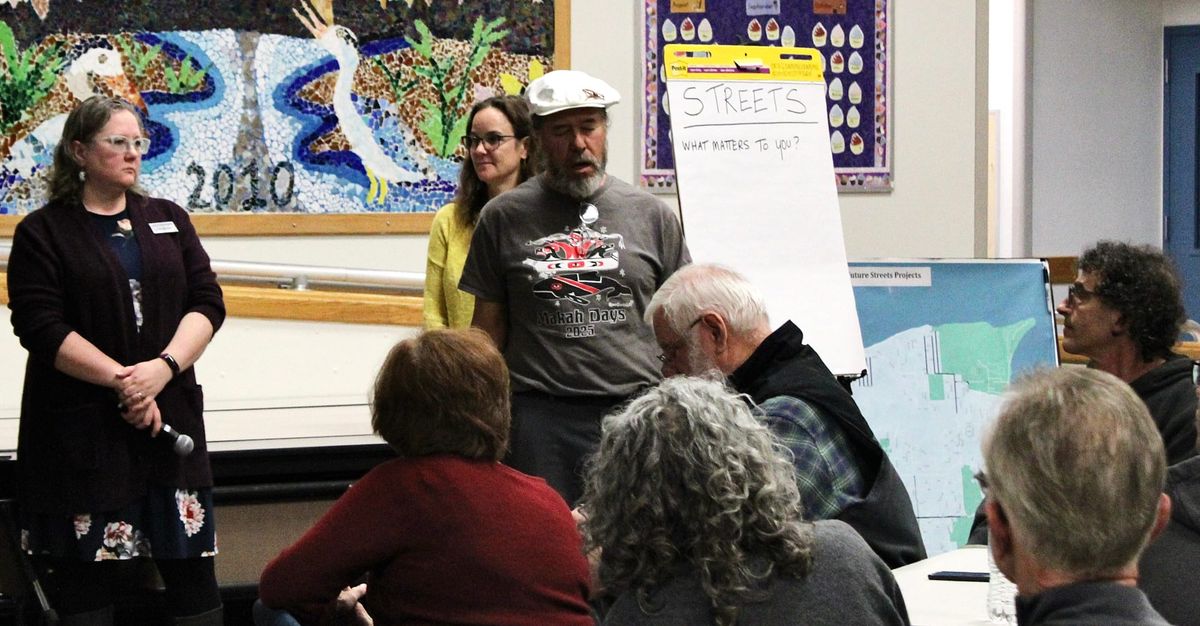
PORT TOWNSEND, WA — The Oct. 12 budget workshop at the Blue Heron Middle School opened with a proper land acknowledgment and testimony from local Indigenous leaders, before turning to the city's finances—where residents filled the room to question council members and staff about items that mattered most to them.
Land acknowledgement
Mayor Amy Howard opened the evening by honoring Indigenous Peoples' Day, noting that this land was home to thriving S'klallam and Chemakum villages. She named the harder parts of the city's history—an 1867 ordinance prohibiting Native dwellings in the downtown area, and the burning of the last longhouses in 1871—and said the council is committed to treating tribal consultation as "a floor, not a ceiling," and to building "communication instead of assumption and partnership instead of paperwork."
Three Indigenous speakers followed. Rosalee Walz, chair of the Chemakum Tribal Council, spoke first in the native language of her people. Hereditary Makah Chief Walter McQuillen then sang and spoke, sharing stories of his family and his people's connection to the area. Long House for the People founder Naiome Krienke spoke last, representing the Chemakum, Quileute and Klallam tribes.
The Chemakum, who spoke a language of the Chimakuan language family related to the Quileute, lived on the Olympic Peninsula for thousands of years before conflict and disease nearly erased their population—so much so that they were long described by outsiders as extinct.
The budget picture
After the acknowledgment, Interim City Manager Steve King walked the crowd through a Budget 101 primer. The city's finances, he explained, break into three buckets: restricted special revenues (like the transportation benefit district and real estate excise tax), self-supporting enterprise funds (water, sewer, stormwater, garbage), and the general fund, which pays for police, courts, jail, the public defender, prosecutor, Jeffcom 911, administration, planning and arts.
"The general fund is always the hardest fund to balance," King said. "It's the biggest fund of the city, and it's the hardest because the taxation levels are not as predictable as rates."
The city is projecting roughly $14.2 million in general fund revenue against $16.3 million in a “wishlist” of expenses—a gap of about $2.1 million. About $1.6 million of that comes from what King called core infrastructure catch-up: a new facilities replacement fund, fleet and IT.
"This year is a little bit harder than what we've experienced in the last three years," King said. "The economy is slowing a little bit, following the state trends."
On utility rates and the 'overcollection' question
King also addressed recent public claims that the city has been overcollecting on utility rates, walking through rate model projections for water, sewer and stormwater.
"What we're seeing is while our budgets were a little bit lower than the rate models, we are hitting revenues very close to what the rate models [project]," King said. "That's good news, because that means we're collecting enough revenue to pay for the projects and the O&M work that needs to be done."
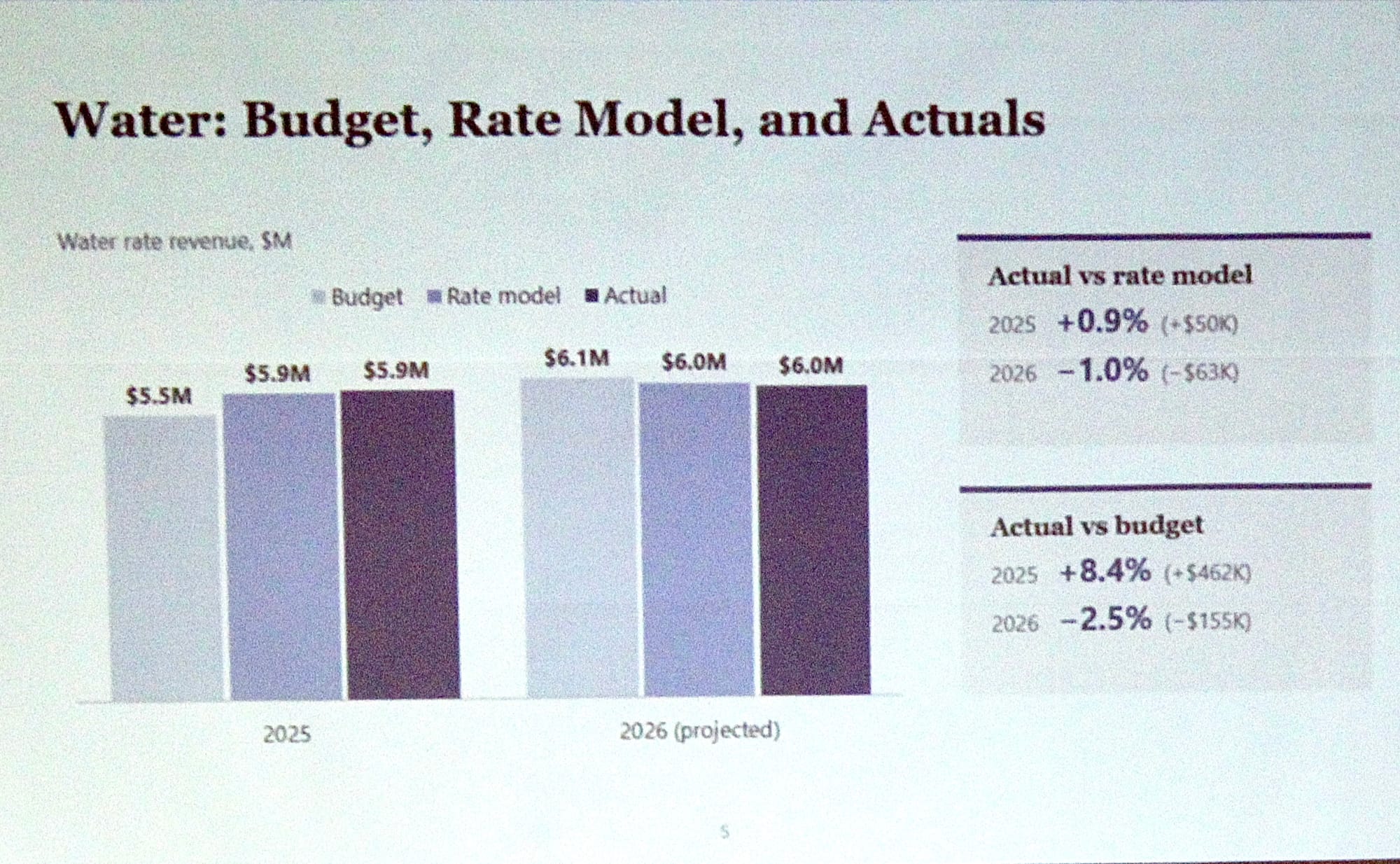
For sewer, King showed 2026 projected revenue of $5.6 million against a rate model projection of $5.7 million. Stormwater is running slightly above projections, which he attributed in part to the urban forestry charge the council adopted in 2024.
"If we were coming in under the rate models, that would be problematic," King said. "We would have to curtail some of the work, or borrow more money. If we're coming in over, it means we need to borrow less money."
He also reiterated a point staff has made repeatedly: utility funds cannot be transferred into the general fund.
"Utilities have to keep their funds separate," he said, noting that some East Coast communities allow such transfers, but "that's a West Coast thing."
Mayor: 'A city shows what's important by what it spends money on'
Howard said the workshop format, the second of its kind, was a deliberate choice for transparency.
"When you see the numbers, and they're in the red, that looks alarming," Howard said. "This is the part where we get to have a conversation about what that means. A city shows what's important to it by what it chooses to spend money on."
She noted that other Washington mayors typically have their staff bring a fully balanced budget to council rather than starting with an open public conversation. "Having the conversation with the community before voting isn't something that we've done before, and it's something that I'm actually pretty proud we're able to do today."
What residents asked about
Six tables covered water and sewer enterprise funds; parks, library and arts; city administration; public safety; housing and economic development; and streets. Council members reported back on what community members brought to each table:
City administration (Howard, City Attorney Austin Watkins and HR Director Cynthia Shaffer): The city manager transition, legal costs, the GMHB case, tort reform, salaries and public records requests.
Water/sewer (Libby Wennstrom, Tyler Johnson, Michael Spears and Bliss Morris): Questions about the water rate study timeline, agricultural uses, and what would happen if the Port Townsend Paper mill—which pays a substantial share of the Olympic Gravity Water System's costs—were to shut down. King said the city studied that scenario in 2021, and that the likely response would be to curtail the water system, eliminate about 10 miles of pipe and one diversion and accept higher ratepayer costs. "The city ratepayers could not absorb the four and a half million dollars a year that the mill is paying," he said.
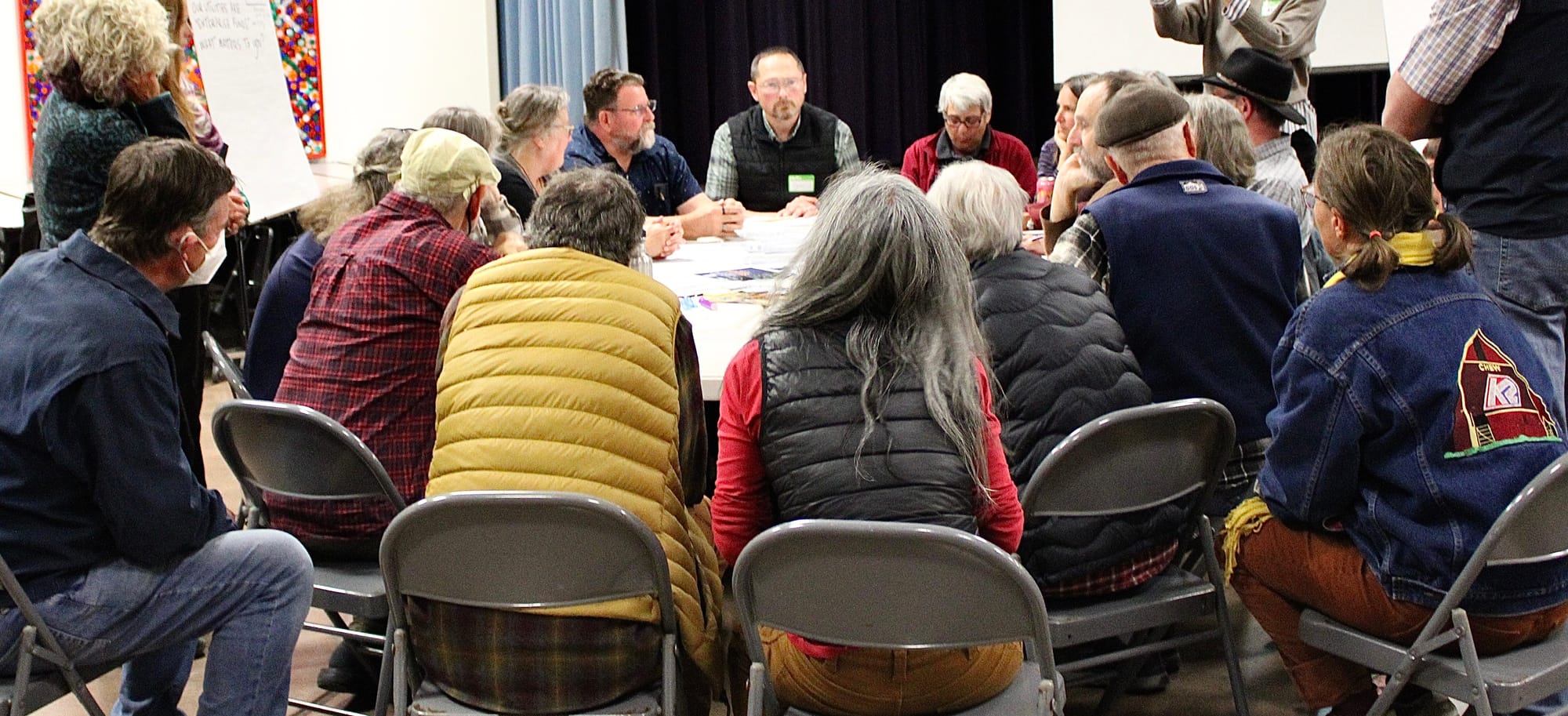
Parks, library, arts (Owen Rowe and Keith Darrock): Funding stability for discretionary services, the library levy (last approved 18 years ago), public art, green space, tree preservation and the possibility of a municipal parks district. Food forests in parks drew visible support.
Public safety (Monica MickHager and Chief Olson): No budget questions, but extensive discussion of bike lanes, deer and Lyme disease, unhoused community members, speeding, harm reduction and trauma training, e-bike licensing for minors, roundabouts and elderly drivers.
Housing and economic development (David Faber and Emma Bolin): Expanding the multifamily tax exemption, focusing on the 30–80% area median income band to house construction workers, staffing up the planning department, AI-assisted plan review, ADUs, tiny houses on wheels, reduced minimum lot sizes, longhouses, transitional housing and port collaboration.
Streets (Neil Nelson and Dave Dinkuhn): Stormwater treatment, less toxic road materials, reducing road miles and roundabouts. "No pothole discussion whatsoever," Nelson said. "Two years ago, that would have been unheard of."
What's next
King outlined a phased approach to closing the gap: reducing one-time requests, phasing in the facilities replacement fund rather than funding it all at once and considering revenue options in 2028, including fee adjustments, voted levies, a metropolitan parks district and a criminal justice tax.
The council will take up the budget again October 19, with the first public hearing on a balanced budget expected November 2, and final adoption a couple of weeks later.