Whatcom County stands out as hotspot for ICE activity
Recent numbers from local governments and nonprofits provide a picture of ICE activity in Whatcom County, some of which appears to be illegal under state law.


By Christy Carley- Salish Current
Recent reports from the Washington Immigrant Solidarity Network, or WAISN, indicate that Whatcom County continues to be a statewide hot spot for ICE activity in 2026.
Volunteers at WAISN keep track of calls and texts coming into the network’s Deportation Defense Hotline and recording any instances of confirmed detentions. WAISN’s monthly reports offer a picture –– albeit incomplete –– of where, when and how deportations are taking place. Across the state, WAISN received 100 reports of immigration detentions in January and was able to confirm 20. Six of those detentions took place in Whatcom County, making it the second busiest county behind King. Seattle and Bellingham stood out as particular hot spots of activity.
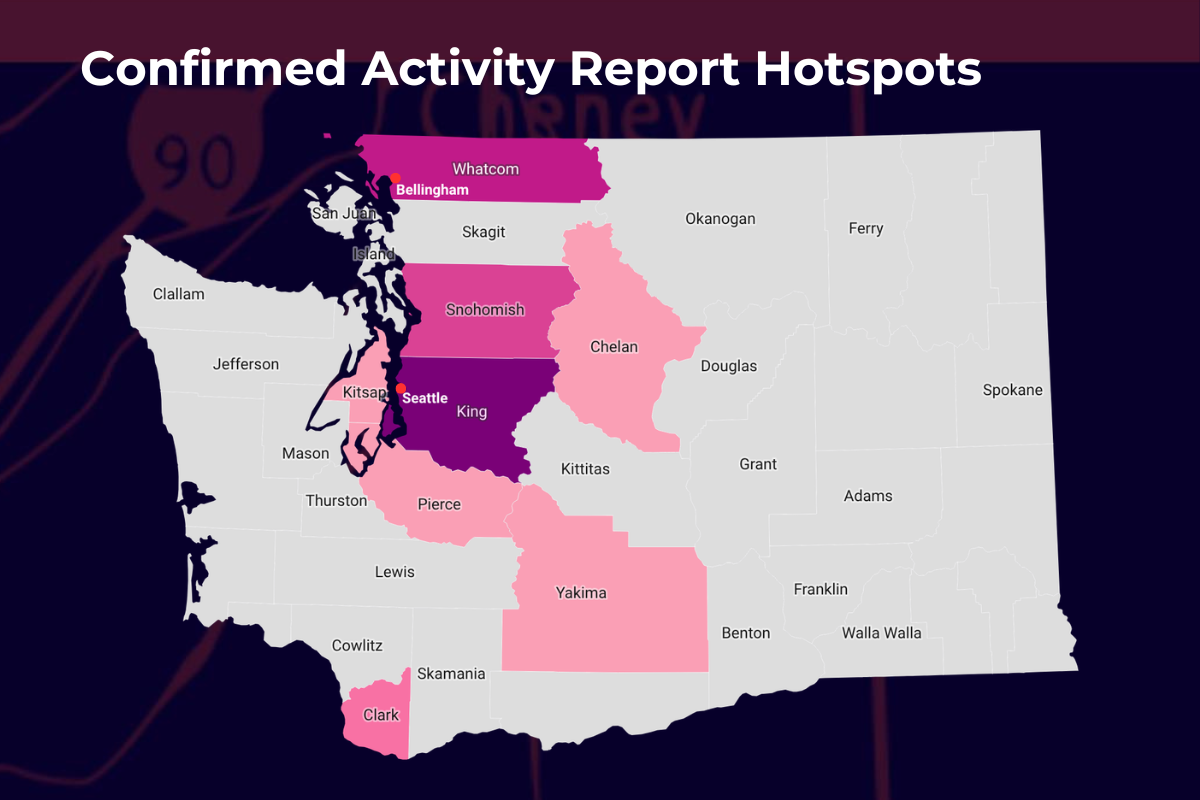
In February, WAISN received 60 reports statewide and was able to confirm 28. Like in January, King and Whatcom County topped the list with another eight detentions in Whatcom. The Whatcom volunteer team confirmed an additional eight detentions in March.
Nedra Rivera, director of WAISN’s statewide hotline and Rapid Response program, said that the true number of detentions in Washington is likely higher than what the organization is able to record, since WAISN’s data is based on information coming via the hotline and community volunteers.
“What we’re sharing is what we’ve been able to confirm,” said Rivera. “We know that it’s not the complete data.”
Trends in the past year
In March, the University of Washington released a report of 2025 ICE activity based on I-213 forms –– documents that ICE agents complete when they apprehend someone who they think is “deportable.” The report emphasized that the definition of “deportable” has expanded in recent months to include some individuals who have work permits or are otherwise lawfully present in the United States. ICE released the data to UW’s Center for Human Rights as part of a settlement in an ongoing legal battle regarding the Freedom of Information Act.
The UW’s report for 2025 includes a per capita analysis, in which Whatcom County comes in third for ICE apprehensions, after Yakima and Franklin counties. The total number of ICE apprehensions for Whatcom County in 2025 was 136, which includes detentions during the high-profile raid on Mount Baker Roofing. From 2022 to 2024, by contrast, the annual number of detentions in Whatcom County ranged from seven to 14.
WAISN also compiled data from their hotline and Rapid Response teams for 2025, in which 61 reports of detentions were confirmed in Whatcom County – only Yakima and King counties were busier.
WAISN’s yearly and monthly reports also include more details on how ICE detentions take place. In 2025, for example, traffic stops made up 28.4% of reported detentions statewide, while detentions in public places came to 17%, followed by detention at immigration check-in. These trends remained similar in February.
WAISN volunteers in Whatcom noted that many of the reports they’ve responded to this year have occurred in Everson, Lynden and other north county locations. Some Whatcom County farmers have also noticed a surge in enforcement.
Changing tactics
When a report of ICE activity reaches WAISN’s hotline –– either through call or text –– local Rapid Response volunteers are dispatched to the scene to observe what’s happening and gather information. Whatcom’s Rapid Response team, which is only a year old, has 40 volunteers who do this work.
In some cases, the call is a false alarm. A caller may have thought they spotted ICE but saw someone from the Sheriff’s department or another law enforcement agency. This can be particularly tricky since ICE agents sometimes drive unmarked vehicles and their clothing and gear can vary.
If volunteers arrive at the scene and an ICE operation is taking place, they focus on collecting as much information as they can about the person being detained and the circumstances of that detention. This might include filming the interaction or photographing license plates. Once the interaction has ended, they approach other bystanders or nearby businesses to gather more information and hopefully locate the family of the person who was detained to help connect them with mutual aid or legal resources.
In the past year, however, ICE’s tactics have shifted, making the work of documenting detentions more difficult.
Local volunteers with WAISN –– who preferred to remain anonymous –– said that ICE has gotten significantly faster at detaining people since last spring, employing what one volunteer called “grab and go” tactics, often leaving detainees’ vehicles abandoned on the side of the road, sometimes with windows smashed. In one instance, volunteers said, a woman was taken from Bellingham’s Sehome Shopping Center while her child was left behind alone.
Immigrations and Customs Enforcement did not respond to requests for comment.
Rivera said that the total number of detainments is likely higher than what WAISN is able to count, especially with how fast some of the operations take place.
Courts Open to All
Bellingham’s Deputy City Administrator, Janice Keller, said city employees have also noticed the speed with which ICE detentions take place.
The city has implemented a voluntary reporting procedure for staff to report ICE activity that takes place on city-owned property. Washington’s Courts Open to All Act prohibits civil arrests — such as those related to immigration — of anyone going to, coming from or present at a court facility unless the arresting officers have a judicial warrant. Officers must check in with the court and provide information about proposed enforcement action before any detainment can take place. The law clarifies that going to or coming from a court includes the area within one mile of the courthouse.
Keller said that since January, the city has been made aware of seven arrests near courthouses –– four near the Whatcom County Courthouse and three outside the Bellingham Municipal Court. But given how fast these operations can take place, it’s possible this is an undercount.
“To date,” Keller said in an email, “no (federal officer) has checked in with the Bellingham Municipal Court as required.”
Jed Holmes, a spokesperson for Whatcom County, said that the same is true at the county courthouse.
“(The) County has posted signs indicating that state and federal law enforcement must sign in,” Holmes wrote in an email. “Over time most of those signs disappeared. We believe that visitors may have removed them.” As of April 15, the signs were visible again at entrances to the courthouse.
Holmes added that court staff report any enforcement activities they witness to the Administrative Office of the Courts, and that the county is working on installing more permanent signage. In an April 10 press release, Whatcom County Superior Court Judge David E. Freeman said that the court has also partnered with community groups to bolster reporting, and regularly receives information from the public about enforcement actions.
“Without such assistance, we would be unaware of incidents occurring near but not inside of the courthouse that may have impacted a community member attending court,” he wrote.
On Feb. 26, Bellingham city staff began installing signs outside the municipal court and library, as well as on other city-owned property, stating that the properties may not be used to stage operations related to civil immigration enforcement.
“City property exists to serve all members of our community, not to be used as staging grounds for immigration arrests, or for other civil immigration enforcement actions,” said Mayor Kim Lund in a statement. “When our neighbors fear coming to public spaces, they miss out on basic services, civic life and social connections.”
Installing the signs, she added, is “unlikely to stop immigration enforcement, but it helps us document such activity on city property so we can support potential legal action related to the laws intended to protect community members.”
WAISN volunteers emphasized that community members worried about immigration enforcement should not be scared away from attending important court dates. Remote options are often available, and WAISN is able to connect people with court accompaniment services.