Affordable Hometown PT Rejects City’s Counteroffer
With no settlement agreed upon, the Growth Management Act appeal continues.

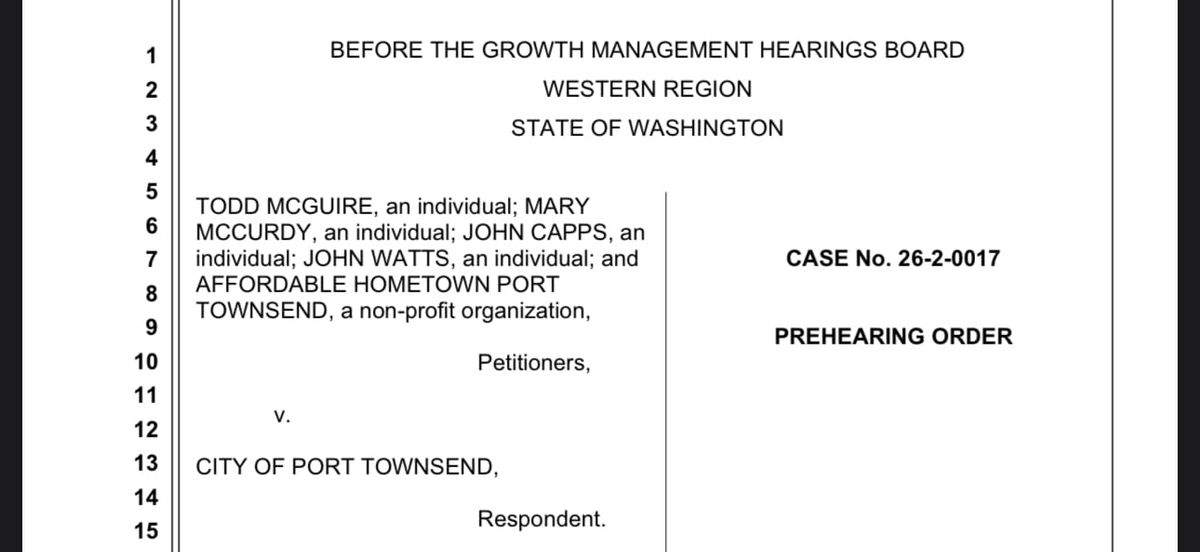
PORT TOWNSEND, WA — An appeal filed by Affordable Hometown Port Townsend (AHPT) against the City’s 2025 Comprehensive Plan amendments remains unresolved following AHPT’s rejection of the City’s counteroffer and the City Council’s previous rejection of AHPT’s proposed settlement terms. Below is a summary based on public documents, City statements and press releases from AHPT.
AHPT’s appeal & counteroffer
AHPT filed a petition with the state Growth Management Hearings Board in February 2026, raising 13 questions about income-band housing targets, displacement and public participation. AHPT President John Watts (a former Port Townsend city attorney) argues the city “failed to identify how the comp plan addresses affordability for different income segments.”
On April 10, 2026, the City counter offered to pursue “potential revisions” to the comprehensive plan to address Growth Management Act compliance issues, including to plan housing units by income band, and agreed to conduct a study on tenant protections.
However, the City stopped short of agreeing to AHPT’s core demands: a temporary moratorium on the December 2025 R-II upzone, a fully reopened public process, binding code changes that limit density, restoring setbacks and requiring infrastructure reviews before permit issuance. The City also noted that it could not predetermine legislative outcomes like density limits or inclusionary zoning outside an open public process.
On May 11, AHPT rejected the City’s April 10, 2026 counteroffer and instead proposed its own terms, which included a temporary moratorium on the December 2025 R-II up-zone provisions, a reopened public process with formal hearings, specific code limits such as six units per structure, restored 5–10 foot setbacks, and 50% lot coverage, as well as an infrastructure review covering parking, water, sewer and stormwater before permits are issued. AHPT states it supports greater density if it is combined with guarantees that some new units will in fact be affordable.
The City’s strategy: 2023 White Paper & 2025 Comp Plan
Port Townsend faces an estimated annual deficit of $17 million needed to build the 85 units of affordable housing needed each year, according to Public Works Director Steve King. The city has made clear it cannot write that check alone.
After two years and more than 60 public meetings, the City Council adopted a new 20-year comprehensive plan in December 2025. The plan’s core strategy aims to reduce the required public subsidy from $17 million to approximately $5–6 million. To achieve this, the city needed to up-zone R-II zones, which were previously limited to single-family residences, to permit multiplexes; expand the Multifamily Tax Exemption (MFTE) program into R-II zones; and establish fee-in-lieu programs, local facilities charges, as well as a Housing Incentive Fund.
These tools were first outlined in the City’s 2023 White Paper on Infill and Attainable Housing. The White Paper explicitly called for zoning reform that “transitions a minimum lot size model to a maximum lot size” and recommended expanding MFTE to R-II zones—the very density AHPT is challenging.
Racial equity context
AHPT maintains that the 2025 Comp Plan fails to address racial disparity in their latest counteroffer. Watts stated the city failed to “properly assess the racially disparate impact of past and future City housing policies, the displacement impact, or other negative impacts.”
City Long Range Planner Adrian Smith has stated that the Comprehensive Plan addresses racial disparity, in part through a racially disparate impact analysis. The city maintains that expanding zoning into R-II zones is itself an effort to combat historically exclusionary housing policies that produced racially disparate outcomes. The up-zone enables future MFTE and fee-in-lieu programs that can produce affordable units.
When explaining how the racially disparate impact analysis contributed to the 2025 Comp Plan, Smith said, “That led to some of the development regulations of change. For example, making it easier to permit duplexes, triplexes and four-plexes, without requiring additional land area, backing directly from the racially disparate impact analysis.”
Restrictive land use has historically contributed to racial segregation and still does today. A February 2026 study from Cambridge University Press details these findings and said, “Specifically, scholars have shown that restrictive zoning (e.g., reserving some parts of a community for single-family development and others for denser, multifamily development) is correlated with racial segregation.”
Staff capacity & the cost of the appeal
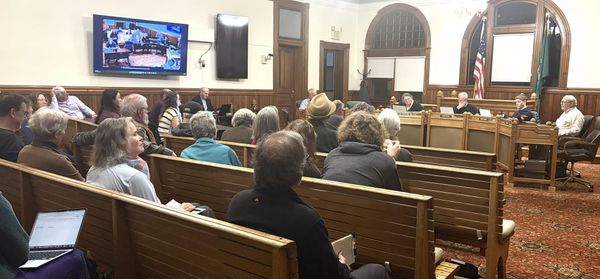
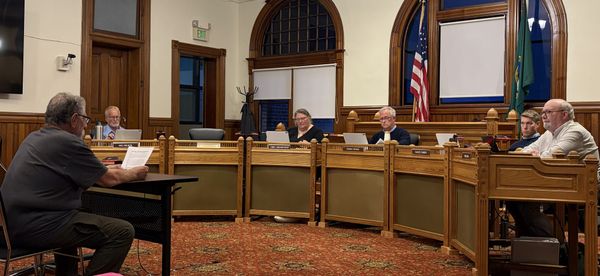
During the March 11, 2026 workshop meeting with planning staff and city council, the impact of the GMA appeal was made significantly clear.
Planning and Community Development Director Emma Bolin has confirmed the department is operating with two professional planning vacancies while facing state-mandated deadlines. The appeal is consuming staff time that would otherwise be used to expand MFTE, design fee-in-lieu programs, and draft tenant protections.
Planning Commissioner Dylan Quarles stated: “It’s disheartening to look at the docket and see that an appeal about a lack of affordability is the only thing that mentions affordability, and that appeal is pushing other potential mechanisms off the docket.”
Council member David Faber added: “If the appellants are actually interested in addressing affordable housing . . . dropping the appeal is the best way to get affordability to our Comp Plan.”
Petitioners’ status & disclosure
The four individual petitioners listed on the appeal (John Watts, John Capps, Todd McGuire, Mary McCurdy) are all homeowners in Port Townsend’s R-II zones. Public records show their combined properties are worth upward of $6.7 million, having appreciated over $4 million between 1999 and 2018.
When asked by the Beacon for alternative funding proposals for affordable housing, donor disclosure, or personal financial interests, only Watts responded, declining to answer directly and referring instead to the group’s website and petition.
What happens next
The state Growth Management Hearings Board has scheduled sessions through August 2026. The City’s 2025 Comprehensive Plan remains in effect during the appeal. If no settlement is reached, the appeal will proceed to a full hearing.
Both sides agree on the need for more affordable housing. Both agree past housing policies produced racially disparate outcomes. They disagree on whether the 2025 up-zone—without a moratorium on the increased density, without a reopened public process and without pre-existing affordability requirements—is the lawful and effective path forward.