
Big Screen Views: “Pressure”
This WWII feature retells the tension building before the June 6th Normandy invasion.

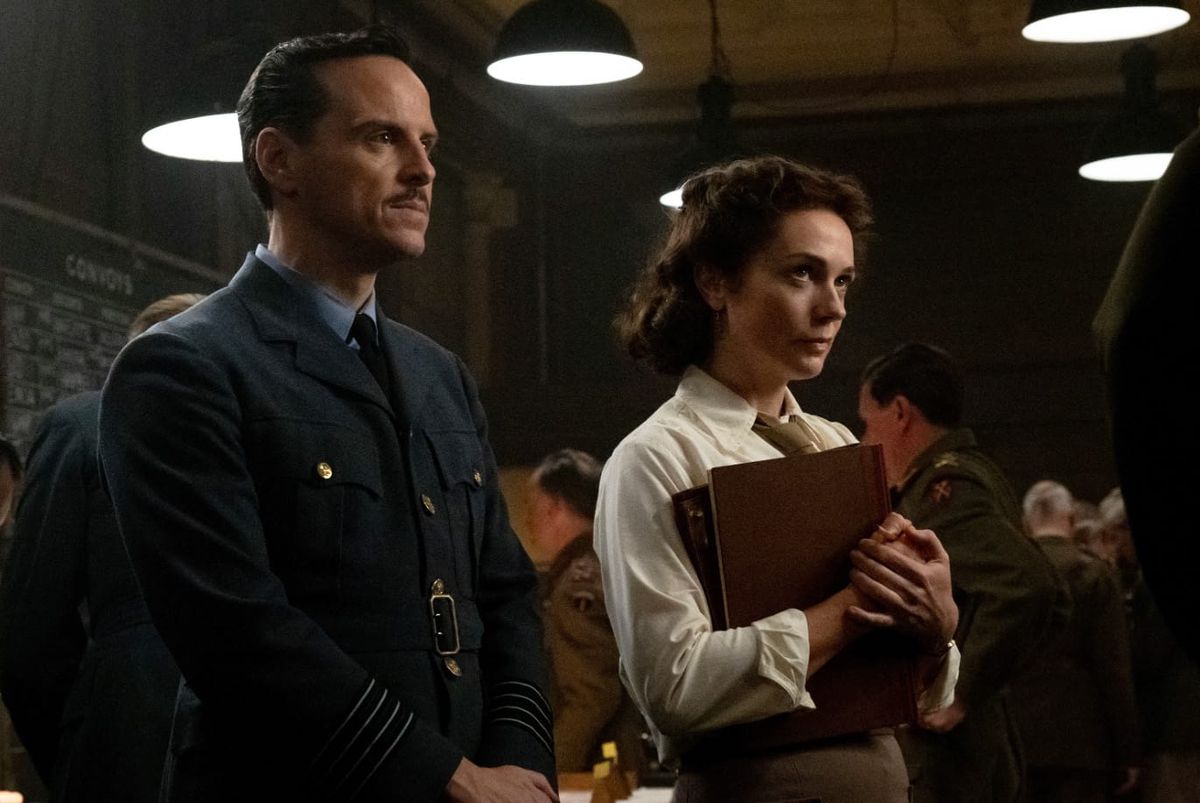
Why see yet another movie about World War II?
Because “Pressure” is as compelling as they come, and because the picture is about human nature and Mother Nature at their worst and best. The movie’s standout stars, Andrew Scott as Dr. James Stagg and Kerry Condon as Capt. Kay Summersby—the lone woman in the war rooms—take us through 100 minutes of suspense in a story that’s overdue for a big-screen telling.
“Pressure” was released into theaters this past weekend, on the 83rd anniversary of D-Day, the Allied invasion of Normandy, France. Directed and co-written by Andrew Maras, the film is an adaptation of David Haig’s stage play. That “Pressure” premiered in 2014 in Edinburgh, Scotland, Stagg’s home country.
In the movie’s first moments, we look straight into the wide eyes of a beautiful boy. This boy is lying in blood and saltwater. He has been robbed of his life in Exercise Tiger, a “rehearsal” for the D-Day’s gigantic air and seaborne assault on Hitler’s army. That practice run turned to disaster, with torpedo-armed German boats attacking an American naval convoy. The convoy lacked enough escort protection, and there were tragic errors in communications.
The landing ships were not warned in time of the enemy’s approach. Germany’s forces sank two American ships and damaged the third, killing 749 soldiers and sailors. In “Pressure,” Supreme Commander Gen. Dwight D. Eisenhower (Brendan Fraser) has this failure weighing on his soul as he positions some 160,000 men for the D-Day invasion scheduled for June 5, 1944.
“Pressure” plays out during the weekend before the Monday operation. The weather forecast was for mild conditions that morning. The Allies, led by generals from the United States and Great Britain, were poised to attack Nazi-occupied France and ultimately liberate Western Europe from Hitler.
But no. Dr. Stagg, a Scot whom British Prime Minister Winston Churchill has labeled a genius, brings bad meteorological news. The jet stream is pulling in not one but two mean storms, he tells Eisenhower and the rest of the officials.
They don’t want to hear it. Col. Irving Krick (Chris Messina), the trusted weather forecaster until Dr. Stagg’s arrival, presents their preferred outlook: It’ll be just like June 5, 1925, when the winds were gentle and the sunshine nice.
Stagg’s stark contradiction: In northern Europe, the weather does not follow historical precedent. His fresh scientific observations and analysis show that the mission-friendly weather seen out the window right now is about to end.
Col. Krick and Field Marshal Bernard “Monty” Montgomery (Damian Lewis) refuse to listen. They remind me for all the world of today’s climate deniers. For them, the facts are just too awful to accept.
Montgomery, a ridiculous man-child, goes so far as to say the soldiers, sailors and airmen should be sent in no matter what the weather. Dr. Stagg pronounces this “moronic.” He’s admonished for insulting his comrades, and responds that this was no insult, but merely a description.
I’d follow this Stagg anywhere. And I hope I follow Scott to the podium at the Academy Awards.
Just as the doctor predicted, the weather changes on June 4, bringing the fierce, just as it does around Port Townsend at practically any time of year. A decision must be made, and several of the war-room contingent disagree. How will the men get through this?
Capt. Summersby, Eisenhower’s personal assistant, uses her formidable powers to keep things from devolving further. The slim Irishwoman is riveting to watch, a commander in her own right.
This is nothing, she tells Stagg. She drove an ambulance through the London Blitz, when there were so many dead bodies in the streets that the cinema was used as a morgue.
“Pressure” takes us inside the room with the generals—and it shows us the unimaginable horror and chaos of the war outside. The movie depicts what our grandparents and parents endured: experiences that continue to reverberate through the generations. Loss, trauma, stolen youth: They don’t go away when the veterans are gone.
The invasion did happen, one day later than it was originally planned. The weather, and with it Stagg’s recommendation, had changed again. The largest naval, air and land operation in history, accomplished its mission. It still took nearly a year for Germany to surrender in May 1945.
“It was gripping, though I knew how it was going to end,” said the woman sitting behind me in the theater.
Agreed. The D-Day weather story is a true tale that needs to be told again, today. I rarely go to war movies. For me, “Pressure” is an above-average anti-war movie.