Big Screen Views: The Invite
Perhaps there’s no such thing as the perfect on-screen sex therapist, but Penélope Cruz sure does come close.

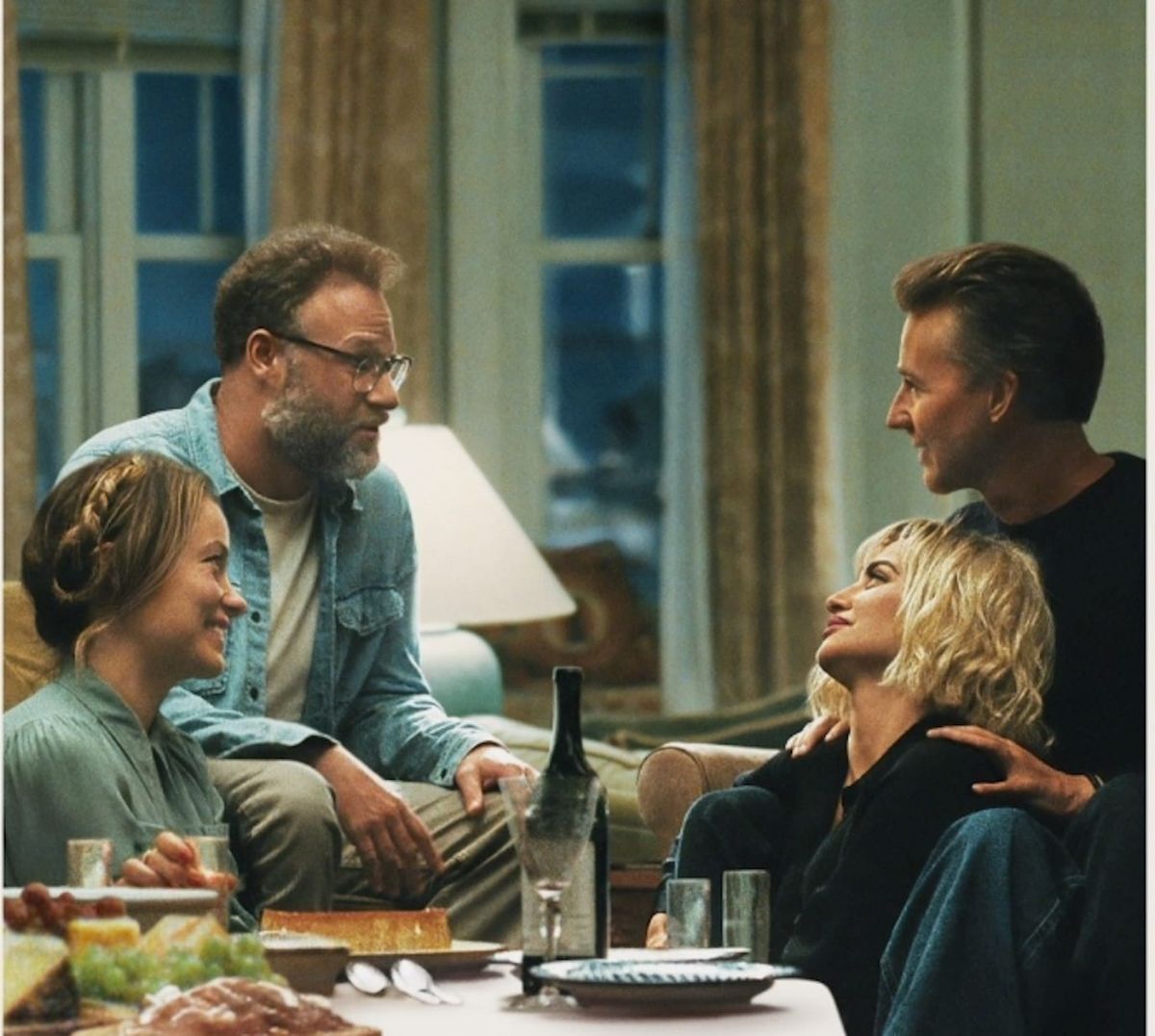
If you’re going to have a sex therapist, let it be Penélope Cruz. That much is clear while watching “The Invite,” in which Cruz portrays Piña, a feminist, counselor, sexologist, partner and quite a good neighbor.
Don’t worry, I’m not going to spend this entire review gushing about the Spanish actor. But Cruz is mesmerizing. She wears her hair in a bleached-blond, messy bob that says, “I do what I please.” She switches from English to Spanish when murmuring to her boyfriend, a guy who calls himself Hawk (Edward Norton). She also provides comic and sultry relief from the strident and self-absorbed characters sharing the space.
“The Invite,” billed as a comedy, drama and romance, unfolds inside the San Francisco apartment of Joe (Seth Rogen) and Angela (Olivia Wilde). We are right in there with them as they bicker about the impending visit from their neighbors Piña and Hawk—the loud-sex-having couple in the apartment above them.
Wilde is also the director of “The Invite,” using a screenplay by yet another couple: Rashida Jones and Will McCormack. The film is based on a six-year-old movie from Spain whose title in English-speaking regions was “The People Upstairs.” It was written by Cesc Gay, who is also the author of the stage play that came first.
Until I saw “The Invite,” I had forgotten how good it feels to be in a movie theater full up with laughter. The Starlight Room is conducive to this experience, especially on a Saturday evening: We were singles, couples and small groups of friends, settling in with wine and popcorn for a rom-com with plentiful hilarity to loosen us all up.
Yet “The Invite” isn’t just a funny romp among good-looking actors. The picture is loaded with longing, fury and desire. The title denotes several kinds of invitations including: Angela asks Hawk and Piña over for dinner; Hawk and Piña try to invite Joe and Angela to a sex party; and Piña asks Angela to talk about how she and Joe got together in the first place all those years ago.
In the beginning, there doesn’t seem to be much hope for Joe and Angela’s marriage. Joe is deep into misery over what he sees as his failed career in music. Angela is profoundly disgusted with him. Their hearts no longer see each other. So when Piña and Hawk show up and seem capable of seeing them, sparks fly.
The arrival of Piña and Hawk is like a door being thrown open. A kind of Pandora’s box of treats, treasures, mirrors and questions rushes in, befuddling the angry couple.
Would participation in a sex party help Angela and Joe’s marriage? Would anything help? How did they get this bad?
And who is this Hawk guy, really? What inspired him to adopt that name? His revelation of the answers gives the movie yet another layer of emotion—and uncertainty, since it’s not easy to tell whether Hawk is speaking the truth.
In a Sirius XM interview, Wilde said “The Invite” is arguing for having “those difficult conversations” with one’s partner. I’m all for this too, because I still believe that in relationships as in the rest of life, the truth will set you free.
“The Invite” does a bang-up job of showing just how awkward and funny the dialogue can be for couples who just want to get to a better place. The story also reminds us of how the memory of your first meeting—or of that moment when you truly saw your person—can be a magic elixir.
But is this a date-night movie? Yes—for the courageous. And don’t forget your sense of humor.