Chlorophyll Corner: Monkey Puzzle Trees and the Memory of a World Fair
These trees are gifts that remind us of our connection with cultures around the world.
Chlorophyll Corner is a monthly column exploring the cultural, ecological, and medicinal relationships between people and plants. Grounded in ethnobotany and the One Health model, it examines how traditional plant knowledge supports our access to land‑based healing across diverse communities.
On the peninsula, we’ve been blessed with cloudy mornings that soften into warm afternoons. This gentle rhythm is in contrast to much of the rest of the world experiencing record high heat waves. Our mild maritime summer against global extremes has me thinking about how climate, culture and community weave together, especially during global events like the World Cup.
I made my way into Seattle this week and found myself captivated by waves of joy, laughter, and more languages than my ears could track. The World Cup brings its own unique complications, but it also creates rare moments of collective celebration. It’s powerful to witness strangers united in joy, to witness communities connecting across cultural and linguistic barriers. That feeling reminded me of another moment in Seattle’s history when the world gathered here: the 1962 World’s Fair.
The Seattle World’s Fair brought many futuristic visions to Cascadia. The monorail, Pacific Science Center, space‑age architecture and the now‑iconic Space Needle were all born from this historic event. The fair also brought something quieter and stranger: monkey puzzle trees!
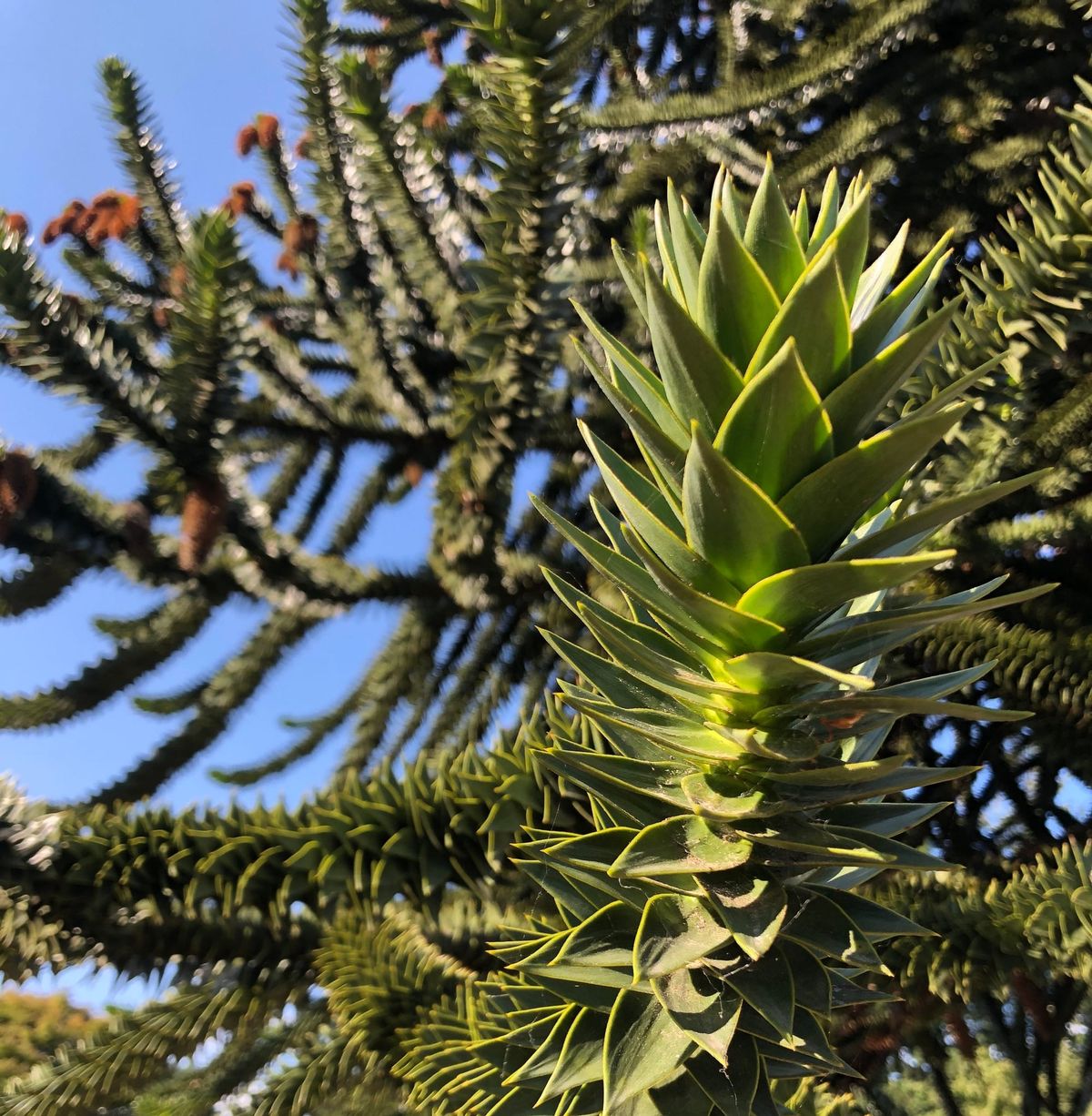
These living fossils, with their rope‑like branches and surreal geometry, look like a Dr. Seuss illustration come to life. The Monkey Puzzle tree, Araucaria araucana, is native to the temperate sub‑Antarctic forests of southern Chile and western Argentina. In their home range, they can reach 100 feet and live up to 2,000 years. Males bear oblong cones; females carry round ones. All of Seattle’s heritage monkey puzzles are male, which is why you’ll never see the prized piñones, which are starchy, nourishing seeds beloved by Mapuche communities, falling onto our sidewalks.
For the Mapuche people, the Araucaria is more than a tree. It is food, fuel, lineage and land. Piñones are eaten fresh, roasted, or added to stews. The tree’s wood has long been used for timber and firewood. Today, Mapuche communities continue fighting for territorial rights and conservation protections, recognizing that their cultural survival is intertwined with the tree’s ecological survival. Massive fires in 2001–2002 and 2014 reduced native populations by nearly half, and the species is now listed as endangered in its native range.
So why does the monkey puzzle thrive in Seattle? In the 1950s and 60s, it was considered one of the coolest trees to own. During the World’s Fair, a booth gave away seedlings to attract visitors to their booth. People brought home baby trees and planted them in their front yards. Many of those saplings are now towering elders in our neighborhoods, quiet reminders of a time when the world gathered in hope and curiosity.
In a time when war and despair feel so close, I find comfort in these trees. These gifts from Chile rooted themselves in Cascadia with ease, asking little, offering much. Like the joy shared between strangers at the World Cup, monkey puzzles remind us that connection across cultures and across continents is possible. They stand as living proof that what we plant together can outlive us, carrying our stories forward for centuries to come.