Chlorophyll Corner: The Ethereal Ghost Pipe and the Changing Seasons
Ghost Pipe sustains itself in community without the sun, much like we must do during the winter.
Chlorophyll Corner is a monthly column exploring the cultural, ecological and medicinal relationships between people and plants. Grounded in ethnobotany and the One Health model, it examines how traditional plant knowledge supports our access to land‑based healing across diverse communities.
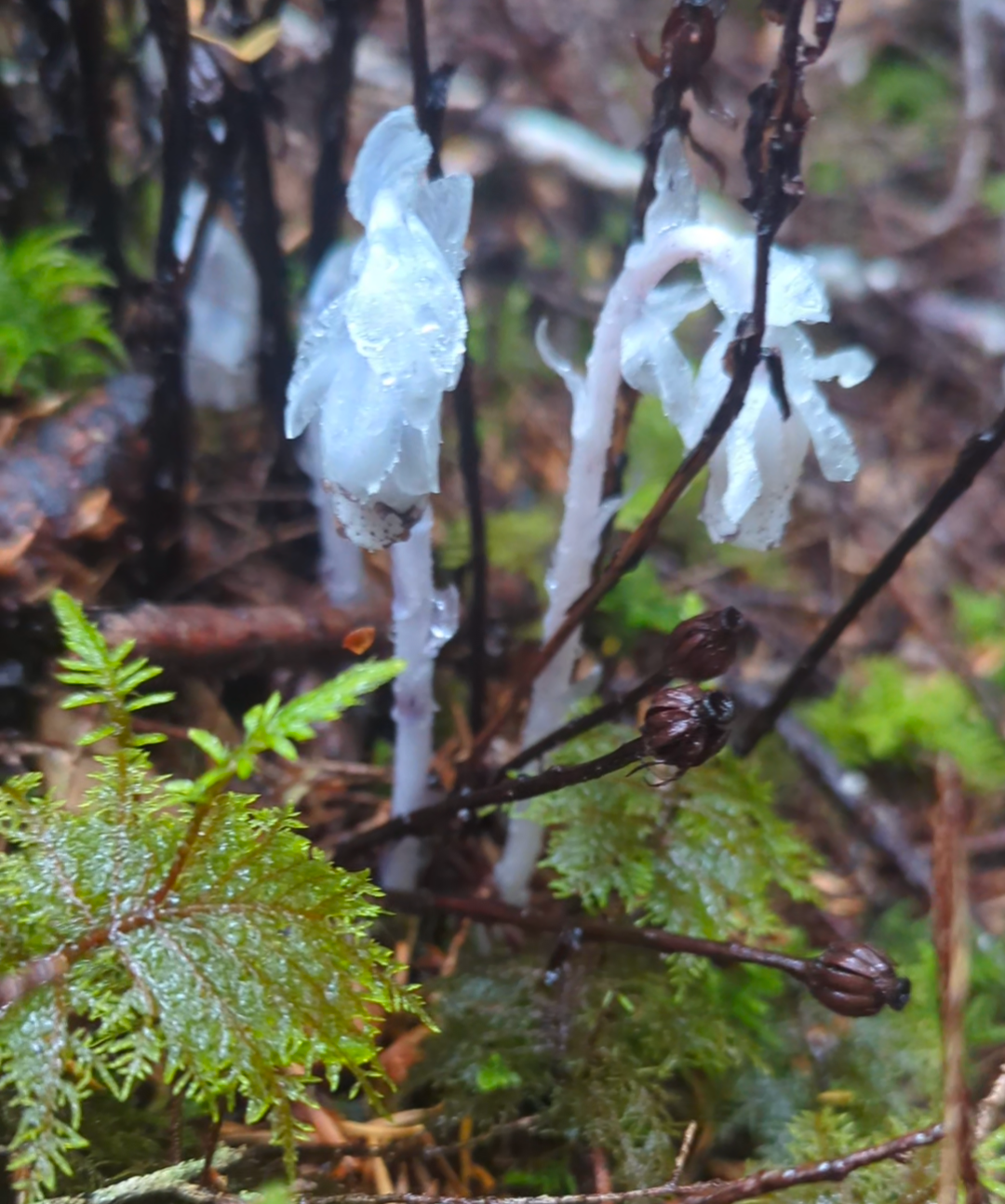
Fall in Cascadia has its own unique enchantment, a season defined by decomposition and return. I went out for my yearly edible mushroom stroll hoping to find early risers and found Ghost Pipes pushing up through the duff instead. This is the largest batch of Ghost Pipe I’ve ever laid eyes on—a pale, otherworldly cluster rising from the forest floor.
Wrapped in a sweater, raincoat and wool wide‑brimmed hat, I wandered through a mist that seemed to fall forever, turning the rainforest into a moody cathedral. I hadn’t found any mushrooms yet, though others had already rejoiced online about their discoveries.
At my core, I’ve always related to Persephone. I move with the seasons the way she does—rising with spring, and once the leaves begin their slow shift from green to gold, I feel the descent begin.
Our descent through fall always leads us toward Halloween, which is better understood in older traditions as Samhain. Many cultures mark this seasonal threshold: Mexico with Día de los Muertos, China and Southeast Asia with the Hungry Ghost Festival and countless others who honor the thinning of the veil.
I recently learned about the Month of Hungry Ghosts, and while there’s no direct cultural connection between that festival and Ghost Pipe, the association bloomed in my mind anyway. Ghost Pipes are hungry too, feeding not on sunlight, but on the life coursing through the trees around them.
Ghost Pipe is an herbaceous perennial that lacks chlorophyll entirely. Chlorophyll is the part of plants that converts sunlight into food, giving plants nutrients and their green coloring. Instead of photosynthesizing, this plant survives by securing its nutrients from nearby trees. Its roots are connected to tree roots via the underground mycelial network.
The lack of chlorophyll gives this plant a ghostly white color; sometimes one might find one with a pink or red. The stems are smooth and waxy, usually 5–30 cm tall, with tiny scales‑like leaves pressed tight against the stalk. Flowers emerge from June through October. I found this magnificent field of Ghost Pipe amongst Douglas Firs and Western Hemlocks.
One might read this and conclude that the Ghost Pipes are hurting the trees, but it’s quite the opposite. Scientifically, Ghost Pipe is part of a complex microbial community. Its roots and lower stems host distinct bacterial and fungal species; some are involved in nitrogen cycling, some in carbon fixation and some in decomposition. It’s a plant that lives in relationship with the trees, giving to one another.
In Chinese and Southeast Asian traditions, the Hungry Ghost Festival falls on the fifteenth night of the seventh lunar month. During this time, it is believed that realms of the afterlife and living are open to one another. Families prepare food offerings, burn incense and joss paper and set empty seats at the table for ancestors.
Learning about this festival while finding Ghost Pipe felt like a cosmic nudge. Ghost Pipe survives by drawing sustenance from the trees around it, appearing as a ghost amongst the trees—often hungry for connection and dependent on the unseen networks.
In our own way, humans become hungry ghosts during this seasonal shift. We feed ourselves more intentionally, prepare for the darker months and tend to our bodies as a form of ancestral care.
From Latin America to Asia and Cascadia to ancient Greece, cultures across the world recognize this transition between summer and winter. Persephone descends. Ancestors are honored. The veil thins. And the forest reveals its ghosts.