Healing Courage – Restorative Justice
How restorative justice is changing the system.

JEFFERSON COUNTY, WA – The Canadian House of Commons Standing Committee on Justice and Solicitor General, now known as the Standing Committee on Justice and Human Rights (JUST), wrote in its 1988 recommendation, Taking Responsibility:
“[T]he media do not report accurately and completely on the criminal justice system—they tend to focus on spectacular violent crimes and lenient sentences . . . The Committee is convinced that the criminal justice system must be explained to Canadians by means of public education and that the community must be given opportunities to be more involved at all levels.”
Restorative Justice (RJ) originated in Kitchener, Ontario, in 1974 and came to the United States in 1978. The 1988 report, Taking Responsibility, led to the Canadian Government’s sentencing reform in 1990.
It is part of the Beacon’s mission to report evenly on the crimes within our community, educate on the legal system’s function and to follow up on the work happening in the community that deals with complex matters like human rights and relations.
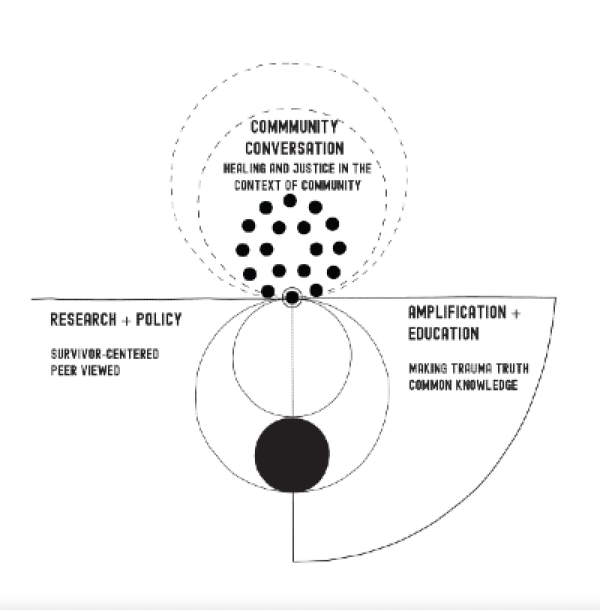
In December of 2024, the Beacon published Restorative Approaches Offer Healing Over Punishment as our first reporting of the reform approach of RJ to our criminal legal system. For that article, we spoke with Brandon Mack, the Superior Court Judge in Jefferson County, and Stephanie Burns, Director and Co-Founder of Healing Courage. They defined justice by those who are most impacted, asking survivors about their needs for recovery and perpetrators what they need to find inner healing.
Then in March 2026, we covered the Peninsula Dispute Resolution Center’s development towards a new program for Restorative Justice Facilitated Dialogues (RJFD) in the Jefferson County criminal justice system.
For our third encounter with RJ, we spoke with Burns again, almost two years later, for an update on Jefferson County’s RJ program progress. With a grant from Futures without Violence, they launched their RJ program in summer 2026, offering non-carceral, community-based options for survivors.
Burns and the team at Healing Courage are asking questions similar to those being asked in Canada in the 1900s, “Is it the purpose of sentencing to exact retribution for the breach of fundamental rules and norms? Should sentencing be attempting to rehabilitate offenders? Should it be inspired by a philosophy of just deserts? How should victims' needs and interests be addressed?”
“One of the things I keep coming back to is that people are complex, and recovery from trauma is complicated and nonlinear,” Burns said. “Our justice system determines guilt or innocence, but it does not know how to hold the complexity of trauma, the impact of violence or the humanity of those most affected.”
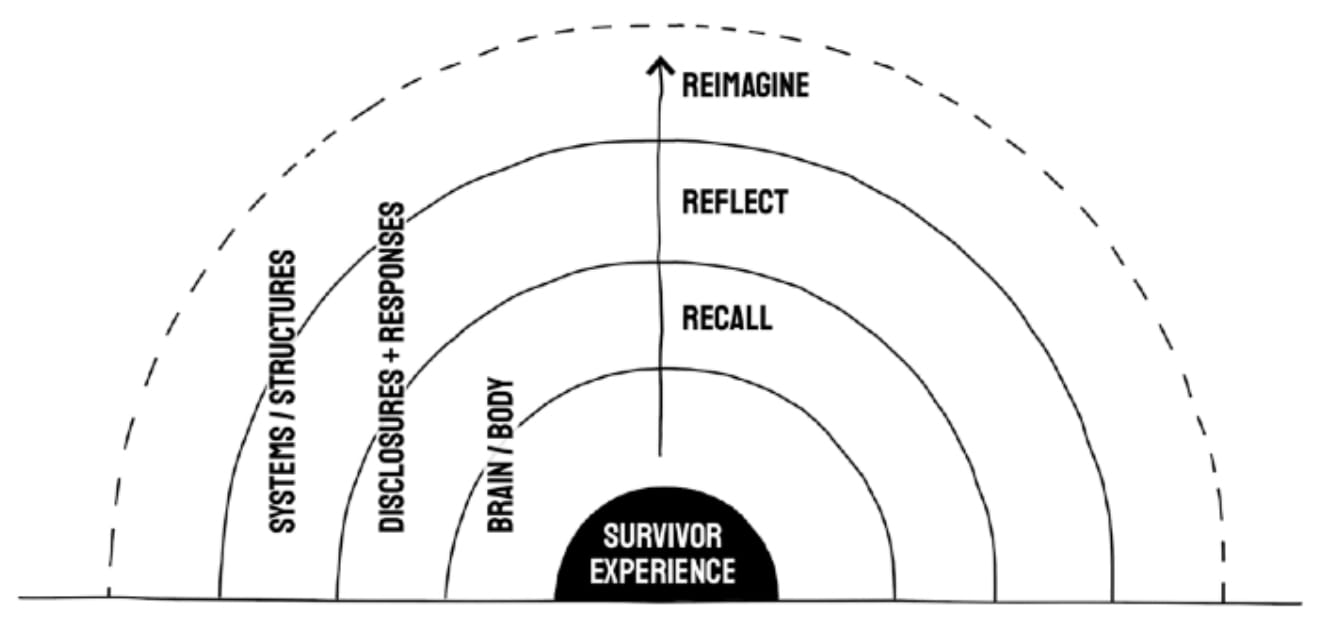
Our criminal legal system is designed to determine guilt or innocence, a black and white outcome in a world of grey human interest. It doesn’t always get it right. Some people who’ve caused harm plead out with lifelong consequences, with no opportunity for conversation with the person they harmed, and survivors lose contact with family members who received harsh sentences they didn’t wish for.
RJ is a victim-offender reconciliation program. A 2002 study found that victim participation was often motivated by the desire to know why the other person did what they did and to communicate the impact that the crime had on them directly to the offender.
“A person may experience harm in one context and cause harm in another,” Burns continued. “Recognizing the humanity of people who cause harm does not minimize, excuse or condone their actions or the harm they’ve caused. At the same time, punishment alone does not necessarily change behavior or make us safer. Accountability can be more meaningful and transformative when it creates space for responsibility, learning, change and the possibility of repair.”
Today, RJ remains largely inaccessible to survivors of sexual violence. Policies prohibit its use in these cases, and Restorative Justice Facilitated Dialogue is not often offered as an option for non-sexual violence cases.
Public Safety Canada cites Aboriginal teachings and traditions of a circle healing process designed to address sexual abuse to improve health and wellness in the community and lower offender recidivism rates, along with significant financial savings compared to the mainstream legal system.
Victim-Offender Reconciliation Programs (VORP), a foundational model of RJ, are now also implemented in Germany, England and other European Nations like Austria.
More research on the impacts and effective components of the various RJ approaches is needed in order to guide further policy development.
“Reforms must address real weaknesses in the system. However, they must also recognize that public concern and the lack of confidence in the system is one of those weaknesses,” Taking Responsibility reads.
The Healing Courage RJ program is now offering informational materials and a way to share personal interest in the program at various locations, including Recovery Cafe, Dove House, Jefferson County Library and Jefferson Associated Counsel.
You can support the work at Healing Courage with donations.
You can visit the Reimagining Justice—Restorative Justice Virtual Art Gallery hosted by the National Center on Restorative Justice at Vermont Law and Graduate School for International Restorative Justice.