Housing Solutions Network Event Explores How Housing Can Build Community
Keynote speaker shares successes in other areas, urges audience to build community

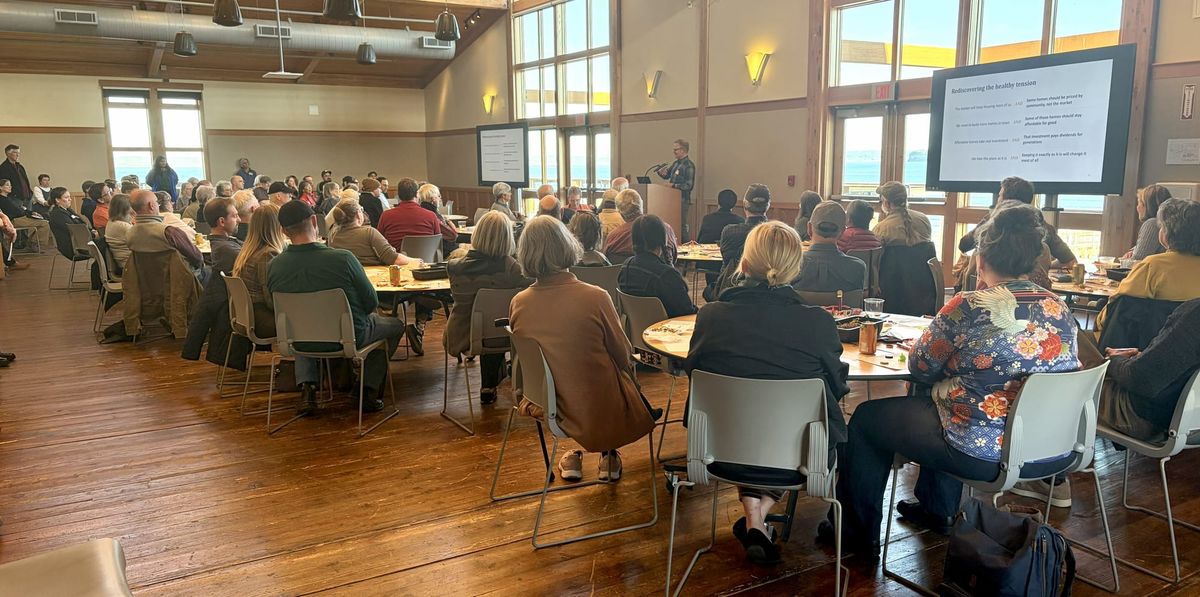
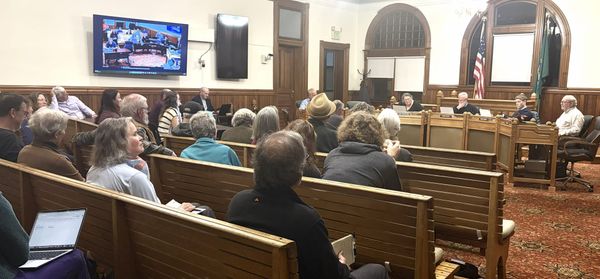
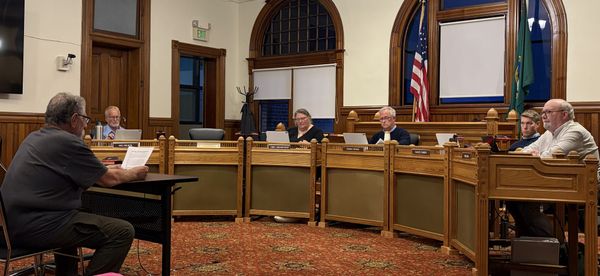
PORT TOWNSEND, WA — Housing Solutions Network (HSN) hosted a community event on October 14, 2026, at the Northwest Maritime Center, bringing together elected officials, representatives from local nonprofit housing providers and engaged community members for an evening focused on reimagining the role of housing in Jefferson County.
The event, themed around how housing can be seen "not just as something we build in community, but as something that builds community," featured a keynote address from Simon Windell, Director of Finance for the Lahaina Community Land Trust, CFO for the Methow Housing Trust and CFO for the Olympic Housing Trust, which serves Jefferson and Clallam counties. He also advises community land trusts, ROC-affiliates, nonprofits, municipalities and developers across the West, and serves as a Planning Commissioner for the Town of Winthrop, Chair of the Okanogan Community Action Council and Treasurer of the Northwest Community Land Trust Coalition.
A catalyst for community
Eric Jones, Executive Director of HSN, opened the evening by reflecting on the organization's role in the community.
"I see HSN as a catalyst, a catalyst for thinking proactively, for growing ideas, for building connections and for creating momentum," Jones said. "We focus on housing as a medium to build community."
Jones highlighted the Mason Street neighborhood in Port Hadlock as an example of what community collaboration can achieve. The project, which broke ground last month, will create 138 homes affordable to local residents, including firefighters, nurses, grocery store clerks and maritime workers.
"The idea for Mason Street was born more than six years ago," Jones explained. "Community members connected at a Housing Solutions Network event, not all too dissimilar from this one."
Jones emphasized that spaces for imagination and discussion are critical to addressing housing needs.
"Someone has to believe things can get better; otherwise, they don't," he said. "But more than that, someone has to imagine what something better could look like."
The housing "crackup"
Windell's keynote address, titled "The Crackup," drew inspiration from F. Scott Fitzgerald's 1936 essays about holding opposing ideas simultaneously. He argued that the housing market is experiencing a crisis of its own making.
"There isn't enough housing," Windell stated. "Making conservative estimates, the county is at least 500 units short, and Port Townsend specifically is at least 200 units short."
Windell presented data showing that 80% of Jefferson County residents cannot afford the median home price of just under $600,000. He also noted that the cost to build a single-family home is approximately $600,000, while the median household of two can afford only $282,000.
"This is a market failure," Windell said. "When the market allocates housing, we lose our socioeconomic diversity."
Rethinking housing as a commons
Windell proposed treating a portion of the housing stock as a "commons" governed by the community, rather than relying solely on market forces.
"Markets exist to allocate scarce goods," he explained. "But scarcity begets scarcity. If we want to imagine a future of abundance, we must think of a better allocation mechanism."
He cited Elinor Ostrom's Nobel Prize-winning work on community governance of common resources as a model for preserving housing affordability for generations.
"We need to treat a portion of our housing stock as commons and govern it as a community," Windell said.
Understanding community land trusts
The community land trust (CLT) model that Windell advocates is central to the permanent affordability strategies he described. In a CLT, a nonprofit organization stewards land on behalf of the community, separating ownership of the land from ownership of the homes built on it. Residents purchase their homes through a long-term ground lease, while the trust retains the land — removing it permanently from the speculative market. When a home is resold, a resale formula set by the trust ensures it remains affordable to the next buyer, typically capping the seller's gain while allowing them to build some equity.
Windell noted that deed restrictions must be structured carefully so homes remain "lendable" — able to be sold on the secondary mortgage market — and that Fannie Mae and Freddie Mac require affordability restrictions to lapse in the event of foreclosure, making foreclosure prevention a key stewardship responsibility.
He pointed to CLTs across the West — from Orcas Island's OPAL Community Land Trust, which has decommodified roughly 10% of the island's housing stock, to the Lahaina Community Land Trust, which has secured 26 parcels toward a goal of decommodifying 20% of Lahaina's housing — as evidence that community governance can keep housing affordable "for generations to come."
Examples from other communities
Windell shared several examples of communities successfully preserving affordability:
Wenatchee, WA: Eight permanently affordable cottages sold for $180,000–$207,000.
Leavenworth, WA: Eight homes sold for $275,000 each, about half market price.
Missoula, MT: An eight-unit apartment complex converted to a limited equity cooperative.
Durango, CO: A mobile home park converted to a resident-owned community.
Lopez Island, WA: Cohorts of households build homes together with buy-ins around $40,000–$50,000.
Orcas Island, WA: Approximately 10% of housing stock decommodified through community land trust.
Lahaina, HI: Community land trust securing land after the devastating 2023 fire.
Holding two ideas at once
Windell concluded by encouraging attendees to embrace conflicting ideas as a catalyst for action.
"We can hold that the market will keep housing most of us, and some homes should be priced by the community and not the market," he said. "We need to build more homes in town, and some of those homes should stay affordable in perpetuity. We love this place as it is, but keeping it exactly as it is will change it most of all."
For more information about Housing Solutions Network, visit https://housingsolutionsnetwork.org/