Port Townsend Council Takes Up Water Rates and Pipeline Costs
An aging pipeline, agricultural users and the mill factor into a complex water rate modeling exercise

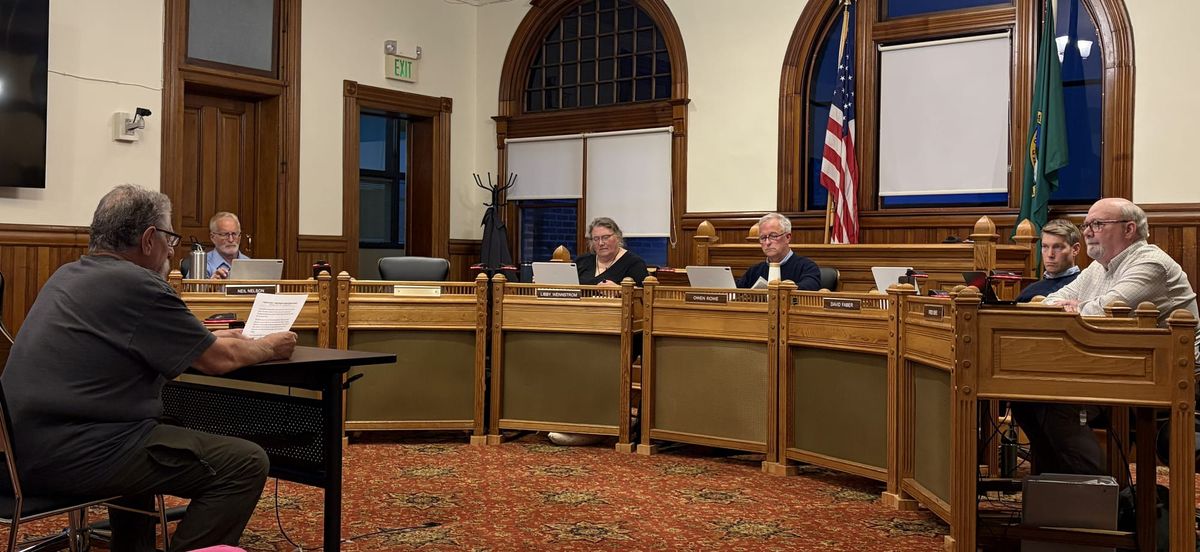
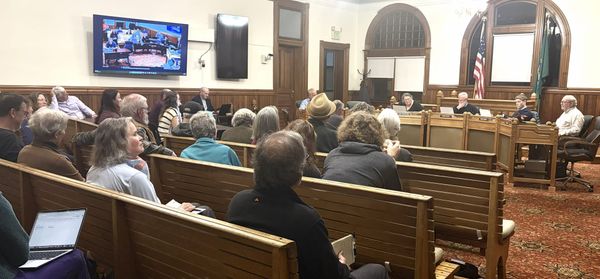
JEFFERSON COUNTY, WA — Port Townsend City Council’s October 19 meeting addressed updating its water rate model for water from the Olympic Gravity Water System (OGWS), the roughly 100–year–old pipeline that serves the Port Townsend Paper Mill and most of the city.
City staff proposed finishing the raw water rates this year, as the 2021 water supply agreement with the Port Townsend Paper Mill requires, and delaying updates to the portable (treated) water rates until April 1.
Raw water currently costs $1.24 per 1000 gallons, a rate the city and the mill pay equally. The complex modeling is about 80% complete, according to the staff presentation.
Large capital expenditures loom
This year, the City created a potable water fund that will separate the accounting from that of the OGWS raw water fund. The mill receives about ten million gallons of raw water from the OGWS every day. Port Townsend customers use roughly one million gallons of water per day, rising to almost two million gallons during the warm dry months.
The mill pays about 90% of raw water costs. Because the city did not want to borrow money for a system so dependent on one customer, and because the mill declined to post a large bond to back such borrowing, King said, OGWS operates as a ”sinking fund,” saving revenue until capital projects can be paid for in cash.
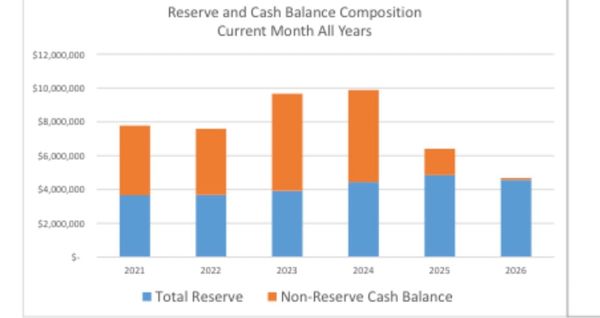
The fund ended 2025 with projected reserves of $12.9 million.
King described work beginning in 2028 that will lead to roughly $40 million in expenditures over five years. He said that staff is proposing two new OGWS positions, an operations employee and a project engineer, which would bring dedicated city staff on the system to four.
“We know that in order to maintain the lowest cost and best return on investment is to make sure the pipeline is operated with a high standard of care, or at least a reasonable standard of care, consistent with other utilities,” King said.
King said that the mill “would like to see substantial reductions in the capital plan. They don’t believe there is a good return on investment for them. They are looking at their short term, and we have to provide water forever.”
He said that the process is not a negotiation, and staff will return November 9 with the mill’s input and preliminary numbers.
The Pipeline’s Condition
An engineering condition assessment by Jacobs Engineering, finished in April, drove much of the discussion. The pipeline is almost 30 miles of welded steel with the oldest section dating to 1927.
Port Townsend resident David Ginsburg said in a public comment that the report documented 24 breaks since 1982, five of them in the last two years.
King noted that the 1927 pipe is in better condition than feared, and the 1940s–era pipe, where welds have been failing, is the real problem.
Several residents urged the Council to price raw water more aggressively. Ginsburg said that a Washington state law, RCW 35.92.010, sets a floor, not a guideline, and that rates must cover the true cost of providing water.
Eve Epstein asked staff to use the right cost parameters in setting capital estimates. She cited the city’s recent water brochure’s estimated cost for capital projects on the OGWS: approximately $3 million for earthquake stabilization at the Lords Lake Reservoir Dam, roughly $10 million to replace the 1946 pipe and $12 billion for a myriad of deferred maintenance projects.
The water rate deliberations seek to establish how much money has to be saved each year in order to pay for critical improvements to the water system to ensure that the water utility remains financially sustainable and viable.
King emphasized the importance of undertaking water rate modeling every five years. “If you just set something and didn’t have that reoccurring evaluation process, you would quickly get behind. So in the next five years, if we find a piece of pipe that maybe needs to be replaced sooner rather than later, that will be reflected in the next rate model. That is the process of establishing the true cost of water and setting the rates to match such.”
Tiers, farms and “the ethos of this town”
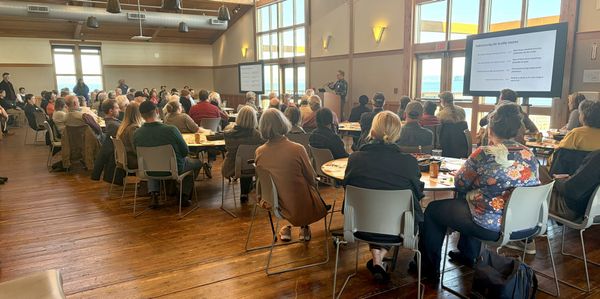
The potable water discussion came late in the evening, in the fourth hour of the meeting.
An outside attorney consultant concluded that urban agriculture can be treated as a proprietary use of water like any business, which differs from the non-binding policy position of the state Department of Ecology. King said some legal risks remain, which staff would like to discuss in an executive session.
Staff is also exploring tiered rates modeled after Jefferson County PUD’s rates, which are designed to reward conservation. About 1,370 of the city’s 4,600 residential accounts move into higher use ranges in summer. King said that because water charges are tied to the cost of service, a tiered structure could raise base charges as people conserve.
Farm owner Jude Rubin said that the PUD–style structure would hurt her farm. The farm doesn’t irrigate for eight months of the year, she said, but would land in the top tier for the other four months, raising its rate roughly 58 percent.
“We’re feeding the food bank, we’re feeding families and it’s the council’s job to represent the ethos of this town with this water rate study,” Rubin said.