How Pending Legal Matters Could Reshape Port Townsend's Street Funding
A critical juncture for Transportation Benefit District planning.

PORT TOWNSEND, WA — City Council and staff gathered on September 14, 2026, for a workshop meeting that would ordinarily have focused on routine street investment priorities. Instead, the proceedings unfolded against the backdrop of the Growth Management Hearings Board's (GMHB) Final Decision and Order issued on August 19, 2026. The GMHB found Port Townsend's 2025 Comprehensive Plan Update out of compliance with the Growth Management Act.
The practical consequence of this decision is severe. While out of compliance, Port Townsend is barred from applying for most future state grant funding. This potentially includes programs administered by the Public Works Trust Fund, the Transportation Improvement Board, the Drinking Water State Revolving Fund and the Housing Trust Fund, among others. The city has already filed a Petition for Review and is currently seeking a joint stay with Affordable Hometown PT (AHPT) to preserve grant eligibility while working toward compliance.
This matters directly for streets. The Transportation Improvement Board (TIB) has been a major funding partner for Port Townsend's road projects, providing grants for chip seal programs, the Lawrence Street Multimodal Improvements Project and sidewalk construction. If that grant funding stream is cut off, the City's carefully constructed street investment schedule could drastically change.
The Transportation Benefit District: Self-funded but leveraged
The Transportation Benefit District (TBD) is the city's dedicated street funding mechanism: a 0.3 percent local sales tax approved by voters in 2023 and first collected in April 2024. The TBD generates approximately $1.2 to $1.3 million annually, allocated across three categories: pavement repair and preservation; grant match for grant-funded projects; and sidewalks, ADA (Americans with Disabilities Act) and active transportation upgrades.
Civil Engineer Mike Connelly explained during the workshop that the TBD itself is not directly dependent on state grant eligibility. The sales tax revenue flows regardless of the city's GMA compliance status. However, the TBD's effectiveness relies heavily on grants. According to staff, the TBD's $3.9 million in committed expenditures through 2029 is matched by roughly $11.5 million in outside funding—approximately three dollars for every TBD dollar spent.
If state grants become unavailable, that leverage disappears. The city would be forced to either scale back planned projects or absorb more costs through TBD funds and the general fund. Staff acknowledged that chip sealing is the most likely candidate for cuts if revenue falls short, because grant agreements cannot be unilaterally reduced.
2027 street investment priorities
Connelly presented a three-year TBD cash flow projection showing a projected deficit of $466,000 in 2027, followed by a $167,000 deficit in 2028, before returning to a positive balance of $183,000 in 2029. The 2027 deficit is driven primarily by large capital projects, especially Lawrence Street. Staff noted that an interfund loan, likely from general fund reserves, will be needed to bridge the gap. Under the city's financial policies, the general fund can provide interest-free loans to other funds, and the TBD has a dedicated revenue source to repay the loan.
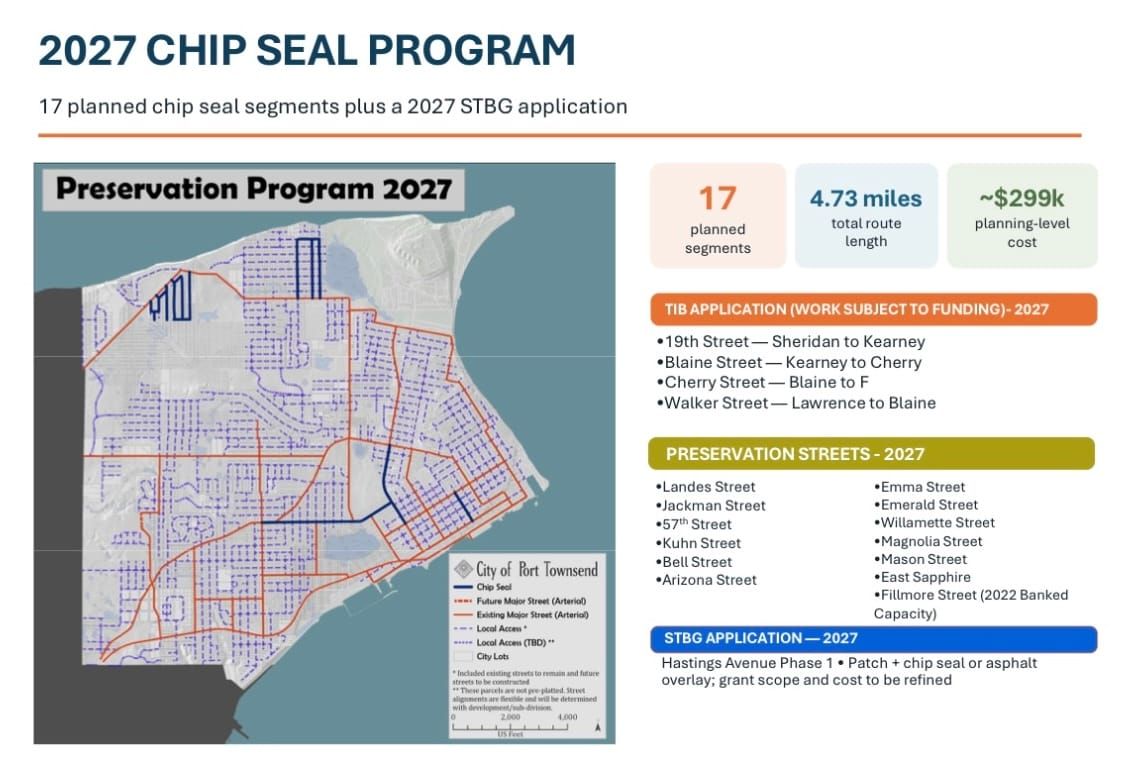
The 2027 work plan includes a chip seal program covering 17 street segments over 4.73 miles, including Bell Street, North Beach and sections of Fillmore. Major repair and rehabilitation projects include Lawrence Street from Blaine to Walker, Cleveland Street, Seventh Street from Gise to Holcomb, plus hotspot repairs on Hastings Avenue and Thomas Street. Grant-dependent projects include Hastings Avenue improvements and the Walker Street sidewalk.
The Lawrence Street Multimodal Improvements Project, currently under construction, was funded through a $2.9 million TIB grant, TBD funds and utility money. If future TIB grants are unavailable, similar projects could stall.
Council discussion
Mayor Amy Howard made an impassioned case for prioritizing Grant Street, citing safety concerns for children walking to school. She described seeing “cars swerve around potholes and nearly hit children.”
Council member Monica MickHager echoed this concern, noting “hundreds of children” use that street twice daily.
Other priority streets mentioned included Clay Street, nominated by a public commenter; 14th Street, which has significant drainage issues and Discovery Road. Staff noted that Washington Street and Lawrence Street carry heavy truck traffic due to the post office and commercial routes.
The conversation also touched on public communication. Staff noted that pothole reporting has increased through the city's online tool, and Communications Director Shelly Leavens shared ideas from a recent conference about making pothole reporting more engaging, including a "Pothole Palooza" competition where residents could nominate their worst potholes for repair.
What comes next
The fate of Port Townsend's street repair schedule hinges largely on either the City’s original stay request or the joint stay request, currently being negotiated with AHPT. If granted, the city remains eligible for state grants while working toward compliance. If denied, the 2027 TBD program, particularly grant-dependent projects like Hastings Avenue, would need to be restructured.
For a city already grappling with a substantial backlog of road maintenance needs, the coming months will determine whether Port Townsend can maintain its momentum or whether the GMHB decision forces a significant recalibration of its street funding strategy.
Correction: Street name spelling was corrected