ILWU Holds Picket at Port Townsend Dock, Pressing American Cruise Lines on Labor
As part of an ongoing action along the West Coast ports, ILWU members gathered at the Union Wharf dock.

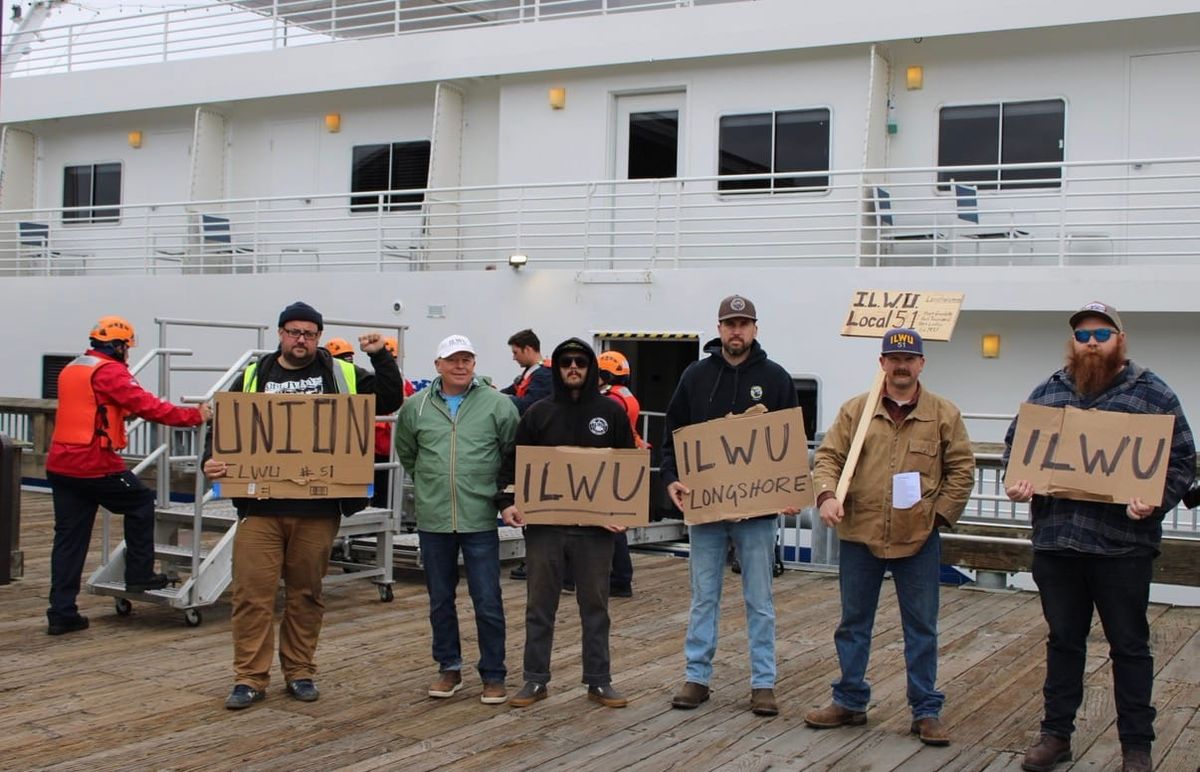
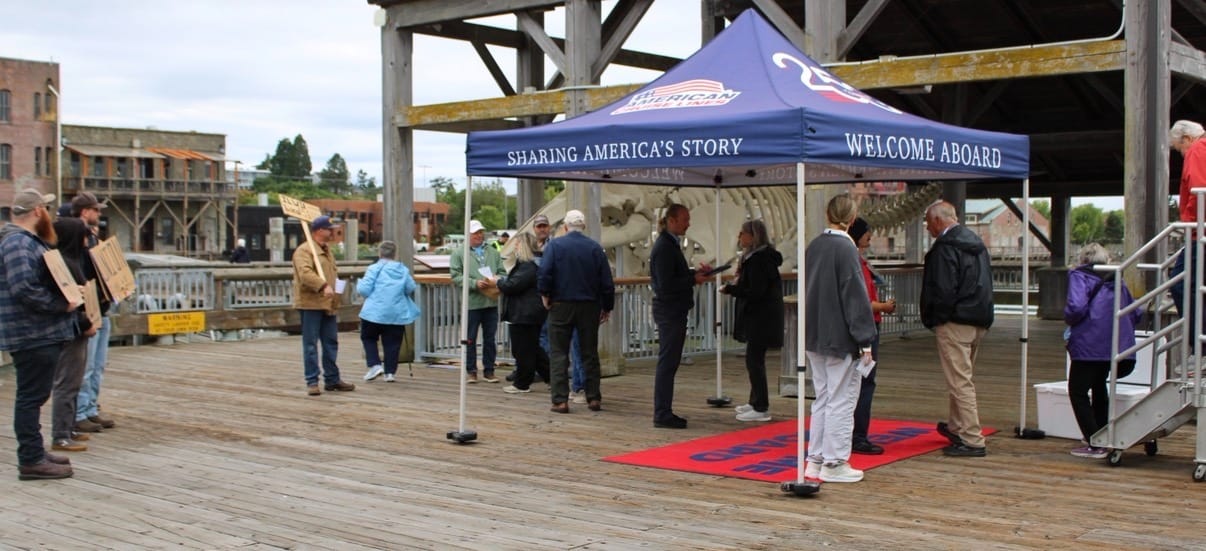
PORT TOWNSEND, WA — A peaceful informational picket unfolded at Union Wharf dock on Thursday morning as members of the International Longshore and Warehouse Union (ILWU) Local 51 gathered to draw attention to American Cruise Lines’ (ACL) refusal to use union longshore labor.
The action, organized locally by Local 51 ILWU members, is the latest in a coast-wide effort to pressure the cruise line to operate “ethically, safely, and equitably.” Unlike many labor actions, the picket was strictly informational: union members explicitly told passengers they were not asking for a boycott or for anyone to cease doing business with ACL.
A union forged in blood: The 1934 strike
The ILWU’s roots run deep in West Coast labor history. The union was established on August 11, 1937, but its true origin lies in the 1934 West Coast Waterfront Strike—a three-month conflict that reshaped American labor.
Before 1934, dockers on West Coast ports were either unorganized or controlled by company unions. In San Francisco, workers were forced to use a hiring hall run by employers known as the "blue book" system. When shipping companies refused to negotiate in good faith, the union held a strike at every West Coast port on May 9, 1934.
Then, on July 5, now known as "Bloody Thursday," police fired into a crowd of picketers in San Francisco, killing two strikers. The incident sparked a four-day general strike that shut down much of San Francisco and the Bay Area. The National Guard was deployed before the conflict ended.
The union won most of its demands in arbitration, including a union-run hiring hall that took over control of hiring and firing from shipping companies. This victory remains central to longshore work today.
What longshoremen do
Longshore workers, also known as stevedores or dockworkers, are responsible for transferring paid cargo throughout dock areas and onto or from ships and other vessels. Their duties involve operating industrial trucks, tractors, and various types of mobile equipment to move containers, crated items, automobiles and machinery around the docks.
They also operate winches and hoisting devices to load and unload cargo, as well as mechanical towers to load vessels with bulk materials such as coal and ore. In addition, longshore workers connect hoses and operate equipment to transfer liquid materials into storage tanks. Their responsibilities further include lashing and shoring cargo aboard ships, opening and closing hatches, cleaning cargo holds and rigging cargo for safe transport.
Today, the ILWU represents approximately 29,000 members across the West Coast, Hawaii, and British Columbia, Canada.
The current local dispute
The Port of Port Townsend does not have a collective bargaining agreement with the ILWU, as port officials have stated they do not perform longshoreman work at the facility.
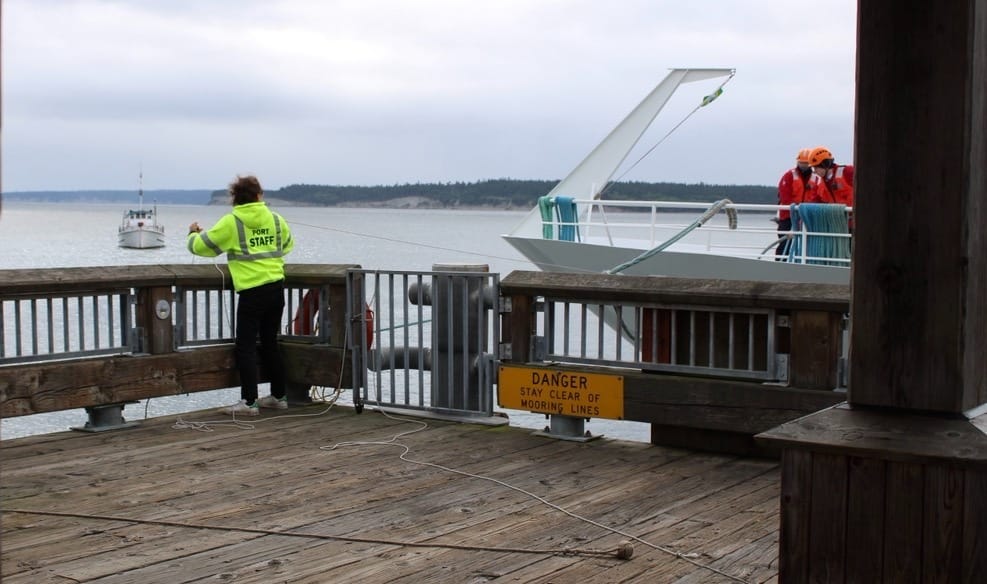
During Thursday's docking, while only one Port of Port Townsend employee was on hand to assist the cruise ship, the boat made rough contact with the dock, causing what appeared to be damage to the dock. The side of the ACL ship collided with the dock hard enough to shake it and disturb the crowd standing on the dock. A member of the public who was casually observing the docking assisted the port employee with securing the cruise ship.
This action from the Longshoremen follows last year’s contentious discussions concerning the number of ACL boats visiting Port Townsend. According to an earlier Beacon article, after a proposed increase in cruise line traffic caused public concern, the Port commissioners voted to increase the fee for a cruise ship docking at Union Wharf to $2000 starting January 1, 2026. They also decided to limit dockings to 40 per year. The increased docking fees are anticipated to fund maintenance of the Union Wharf dock.
Eron Berg, the Executive Director of the Port of Port Townsend, explained to the Beacon that there is no agreement between ACL and the Port to provide assistance with docking, but rather they offer one Port of Port Townsend employee to assist ACL as a courtesy.
Flyer welcomes passengers, not confrontation
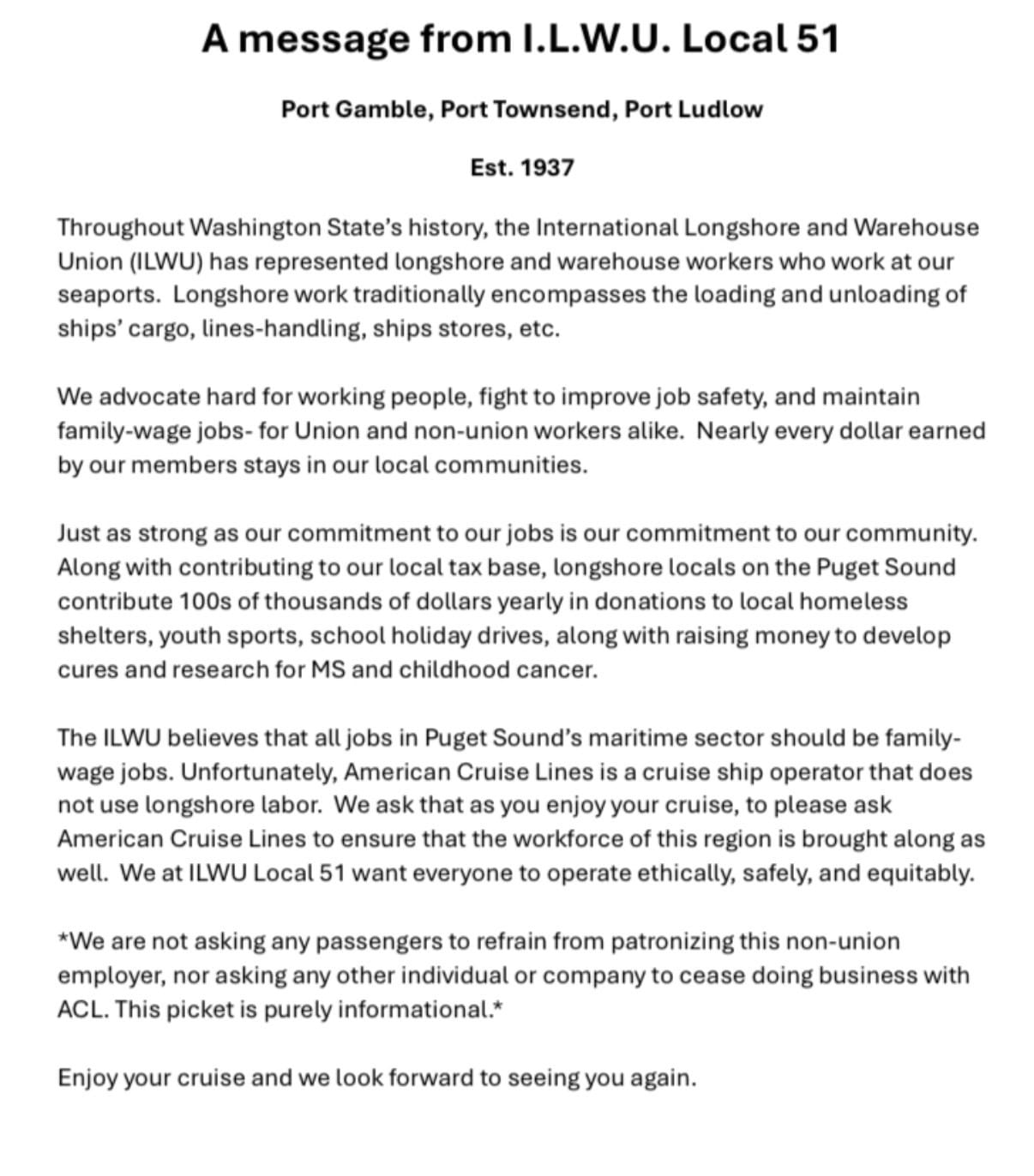
As passengers from the cruise ship disembarked, they were handed a flyer from ILWU Local 51, which represents Port Gamble, Port Townsend and Port Ludlow. The flyer explained the union's history and its role in the community.
"Nearly every dollar earned by our members stays in our local communities," the flyer reads. It also noted that Puget Sound longshore locals donate "100s of thousands of dollars yearly" to homeless shelters, youth sports, school holiday drives and MS and childhood cancer research.
Crucially, the flyer added: "We are not asking any passengers to refrain from patronizing this non-union employer, nor asking any other individual or company to cease doing business with ACL. This picket is purely informational."
Part of a wider Pacific Coast campaign
The Port Townsend action is the ILWU's 17th informational picket against ACL, according to a Local 23 union member from Tacoma. Similar protests have occurred in Tacoma, where ILWU Local 23 recently reminded the public that their predecessor union, the Stevedores, Longshoremen and Riggers Union of Puget Sound, was founded on the waterfront in 1886.
"Every job on the Tacoma waterfront should be a union job, and we won't settle for anything less," ILWU Local 23 stated publicly on social media.
For now, passengers boarding ACL vessels in Port Townsend will continue to be greeted not with hostility, but with a flyer and a request to ask the cruise line to bring along the local workforce.
"Enjoy your cruise," the flyer concludes. "We look forward to seeing you again."
For more information, visit ilwulongshore.org.