Ongoing Turmoil After Quilcene Food Bank Moves Locations
Allegations of mismanagement, missing funds and a community in the middle.

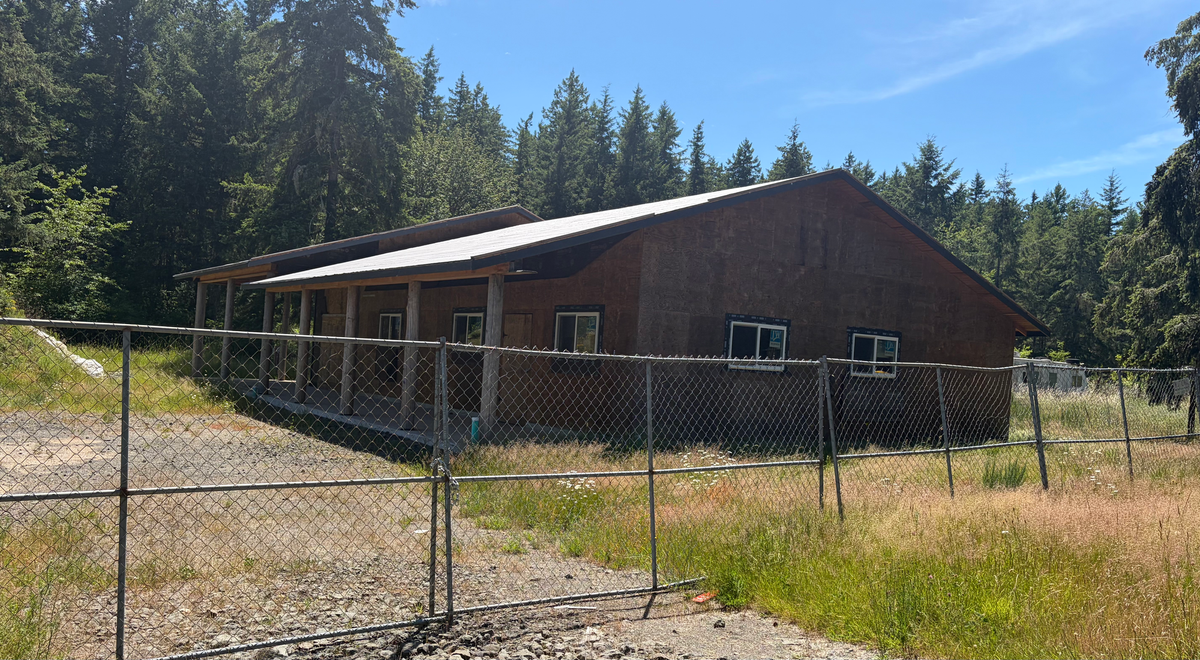
QUILCENE, WA — For decades, the Jefferson County Food Bank Association (JCFBA) operated quietly as a volunteer-run network serving some of the most vulnerable communities on the Olympic Peninsula. But behind the scenes, a series of allegations has emerged, of financial irregularities, workplace dysfunction and a disastrous construction project, throwing the organization into turmoil and leaving donors and clients asking where the money went.
A 2024 independent forensic audit has revealed more than half a million dollars in unapproved construction spending and thousands of dollars in missing donations, according to the report. The fallout has included the departure of dozens of volunteers, accusations of theft and intimidation, and ongoing investigations.
Recent history
A building project spirals out of control
At the center of the controversy is the unfinished Quilcene Food Bank building—a project that, according to auditors and board members, began with a modest budget and ballooned into a financial catastrophe.
The property at 161 Herbert St. in Quilcene was listed for sale in October 2025 at $250,000, a fraction of what was allegedly spent. According to an audit conducted by Insightful Analytics LLC, 96% of payments totaling more than $500,000 were issued without required approval or invoice support. The project's vendor contract, auditors found, was not competitively bid and included a 72-hour payment clause that made oversight "difficult to enforce."
In a November 2024 statement, then-JCFBA president Craig Uchida alleged that roughly $650,000 was spent despite an original budget of just $197,000 and that finishing the building would require more than $1.6 million. The approved site plans, he noted, provided only six parking spaces, insufficient for the more than 120 clients who visit the Quilcene Food Bank on distribution days. Uchida left the board shortly after.
"The project was launched without a capital campaign or dedicated building fund," Uchida wrote.
Patricia Hennessy, who was hired in November 2023 as the organization's first paid executive director, has claimed that she quickly realized the project lacked a budget and capital project fund, with money being pulled directly from general operations. By the time construction was halted in April 2024, the organization had already put $675,000 into a building that was "probably only 15 percent complete," according to Hennessy.
The audit: allegations of a system without controls
The audit raised serious questions about the organization's financial practices. The audit revealed that 17 bank accounts were being managed across six different banks, reportedly with minimal documentation or approval tracking. It also found that thousands of dollars in checks and cash donations had been documented but never deposited into JCFBA accounts, a situation that has since been referred to the Jefferson County Sheriff's Office.
Additionally, the organization's checking accounts received compliance scores ranging from just 52 to 74%. The audit further noted a failure to consistently value donated food and volunteer labor, which allegedly led to the organization's overall financial picture being understated on federal tax filings.
"Every single food bank had its own bank account, and those accounts were being managed by volunteers," Hennessy said, according to an article published in the Peninsula Daily News on September 25, 2024. "That is a huge sweeping change."
Hennessy left her position as Executive Director on November 14, 2025.
John DiMaggio, the board treasurer, described the situation in stark terms in mid-2024, pointing to what he called "fiscal irresponsibility" by the prior board and warning that the consequences were "serious and complex." He noted that the investigation remained ongoing due to the complicated nature of what the new leadership was working to understand. The board has since completely changed.
Current issues
Allegations of intimidation and a toxic environment
The financial turmoil was accompanied by deep personal conflict and, according to multiple whistleblowers, a pattern of intimidation tied to the community center where the food bank was once housed.
The Quilcene Community Center, managed by Richard Fitzgerald, was the original location for the food bank before the organization recently relocated. Volunteers who spoke with the Beacon have alleged a volatile environment under Fitzgerald's leadership—claims he declined to respond to despite expressing a desire to do so.
According to multiple sources, Fitzgerald is alleged to have a history of angry outbursts that left volunteers rattled. In one instance, a source alleged that Fitzgerald threatened an elderly volunteer, telling him he could "crunch you up and dunk you like a basketball." In another case, a woman was reportedly reduced to tears after being screamed at, with the incident later becoming the subject of an ongoing lawsuit.
The food bank's decision to leave the community center, sources allege, came after a dispute over a leaky roof that caused mold in food storage areas. When volunteers asked for repairs, they said they were met with resistance and eventually a new lease that gave Fitzgerald broad authority to shut down food bank operations at any time.
In a letter to OlyCAP leadership, one volunteer stated that the letter warned that Fitzgerald's behavior posed a liability risk, particularly given his role supervising teenage boys at weekly events. "If one of them goes against something he says, and he loses it on a kid, on a minor, you guys remain [in] fat trouble," the volunteer wrote.
OlyCAP, which manages the community center where the food bank was once housed, has not yet responded to requests for comment.
The official reason for relocation
In an email to the Beacon, current JCFBA Board President Roland Faragher-Horwell provided a different explanation for the move. He stated that in early April 2026, the board was presented with a new rental agreement containing multiple terms and conditions, and was asked to start paying monthly rent. This prompted the board to reassess their needs.
Given that the JCFBA had acquired a full-featured warehouse in Port Hadlock by late 2025, they concluded they no longer needed on-site storage or refrigeration at the Quilcene Community Center. This allowed them to operate the Quilcene Food Bank as a "pop-up" and eventually relocate to the nearby Masonic Hall.
The Masons made the hall available, and the food bank began pop-up operations there on June 5, 2026. The new location is larger and offers potential for expanded hours. Faragher-Horwell noted the board is "delighted with the Masonic Hall" and has no formal plans to move again at this time.
A path forward
The JCFBA has overhauled its financial systems in response to the audit. New policies include banning volunteers from handling cash, eliminating site-level checking accounts, centralizing all payments through the main office, and adopting a new policy for standardizing donation and volunteer hour reporting.
The current board, now a six-member body with a full-time executive director, has pledged to conduct random transaction reviews and present findings at monthly meetings.
Yet the stakes remain high. The JCFBA serves about 3,300 households, a number expected to grow to 4,000 following severe cuts to SNAP benefits. Donations, meanwhile, have decreased—a troubling sign for an organization that has lost the trust of some in the community.
For clients who rely on food banks, the hope is that transparency and accountability will ultimately prevail, and that the organization's mission of feeding the hungry will take precedence over the politics that have consumed it.
"Feeding the hungry should always take precedence over politics," one longtime volunteer said. "There are people hurting in our community."
Why we are reporting on this
Over the last several years we have received emails from volunteers, former managers, contractors and people who rely on Jefferson County food banks. Though much of the information we’re sharing today has been public knowledge for some time, the recent move away from the Quilcene Community Center elicited concerns from some readers that we felt needed to be addressed.
Where we got our information from
This article is based on interviews with current and former volunteers, board members and community members, as well as public records and the forensic audit conducted by Insightful Analytics LLC. The Jefferson County Sheriff's Office has not yet announced any charges or findings in its investigation. Richard Fitzgerald declined to comment. OlyCAP did not respond to requests for comment.
Corrections: an earlier version of this article included a quote that was, according to the source, taken out of context, and didn't clarify when the Hennessy left her position as executive director. We also clarified where she was quoted.