Port Townsend Council Keeps Moratorium on 5-6 Plex Permits, Eyes Budget Priorities
After the public hearing, staff and council discussed budget balancing prior to community workshop meeting.

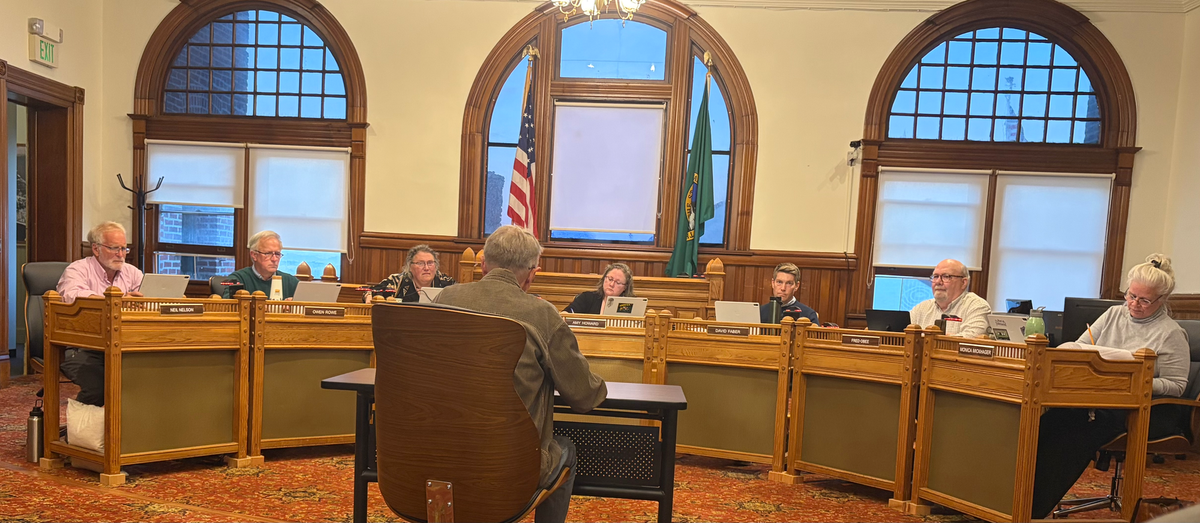
PORT TOWNSEND, WA — City Council held a public hearing on Ordinance 3369 during its October 5 meeting, moving forward with a moratorium on the acceptance of permit applications for new buildings in the R2 zone exceeding a residential density of 32 units per 40,000 square feet (4plex per lot)—effectively pausing applications for 5- and 6-plex developments.
The moratorium was originally adopted two months ago as part of the city's work plan responding to a Growth Management Hearings Board (GMHB) decision that invalidated portions of the city's 2025 Comprehensive Plan. The public hearing was a statutory requirement under the Growth Management Act.
City pursues new legal strategy
City Manager Steve King confirmed that Port Townsend has withdrawn its stay request from the GMHB and is instead seeking a stay from Thurston County Superior Court. City Attorney Austin Watkins explained that the move was intended to "position us to be more clean in our motion to Superior Court." The city is also requesting an amicus brief from the Department of Commerce to seek clarity on what the city characterizes as a confusing order from the GMHB.
Watkins noted that one of the city's central arguments is that the GMHB "exceeded their statutory authority in issuing the invalidation on the related amendments."
Public comment
The hearing drew both written and in-person testimony from residents on the city's approach.
John Watts, representing Affordable Hometown Port Townsend (AHPT), which brought the original challenge, pushed against the moratorium that only restricted 5-6plex permits and urged council “to re-think the scope of its moratorium,” implying restricting the 4plex increase as well.
Dylan Quarles, commenting as a private citizen, urged the council to treat the 32-units-per-40,000-square-foot standard as "a floor, not a ceiling," and asked the council to expand the Multifamily Tax Exemption program to cover all of R-II immediately.
Debbie Nelson, who lives next to a fourplex, offered simple testimony: "It fits in with the neighborhood. It has no adverse effect on my property value . . . They should sprinkle four-plexes all over the place."
Others, like Teresa Sisk and Mary McCurdy, urged the council to accept the GMHB decision (no density increases) and raised budget concerns.
Of the 20+ public comments, most input supported the city’s moratorium.
Council discussion
Councilmember Libby Wennstrom clarified the intent behind the moratorium: "The reason that we put this moratorium in place was to keep things focused on the pieces that had gone through the full public process, while we were in the process of doing this remand work." She noted that the 5- and 6-plex option had been available for applications for eight months, with no applications received.
Councilmember David Faber expressed frustration with the pace of progress: "We need to stop rearranging back chairs on the Titanic . . . and really focus on doing more to address our significant needs in this community."
Budget workshop scheduled for October 13
At the same meeting, Finance Director Jodi Adams and City Manager Steve King presented the proposed 2027 preliminary budget, which currently shows a shortfall of about $2.1 million if all items are pursued. The city has scheduled a community budget workshop at Blue Heron Middle School on Monday, October 13, and encourages residents to attend and participate in discussions about budget priorities and potential solutions.
Adams explained that the workshop will feature tables where community members can ask detailed questions about how the budget is planned and how different departments are funded. "We welcome the public to join," she said. "We'll have tables set up for everybody to ask detailed questions about how we plan the budget or how we're funding our different departments."
The city will then return to the council on October 19 with input received from the community session, along with themes and ideas for reducing the unbalanced portion of the proposed budget.
Key budget challenges include rising contract costs, a $1.4 million facilities replacement for the Mountain View property and a projected $2.1 million in one-time expenditure requests. The council is considering a range of options, including reducing facilities replacement funding, implementing a hiring freeze and exploring new revenue sources.
Other business
The meeting also included proclamations for Resilience Awareness Month and Food for All Day, recognizing the Resilience Project and the Jefferson County Food Bank Association's 41st annual WAVE food drive. The council also approved a grant agreement for library capital improvements, including HVAC and elevator upgrades.
During the city manager's report, King announced successful grant applications to the Public Works Board, including a $250,000 pre-construction loan for the Monroe Street lift station and a $1 million loan for the Holcomb Street sewer pipe replacement. The city applied for these grants before the GMHB decision.
What's next
The city awaits action on its stay request to Thurston County Superior Court. The moratorium remains in place as the city pursues what King described as the "underlying issue" of housing affordability funding.
Residents are encouraged to attend the budget workshop at Blue Heron Middle School on Monday, October 13, to share their priorities with the city.