Ferries Canceled as WSF Engineers Call Out Sick Amidst Contract Talks
A new contract was due October 1 between MEBA and the state.

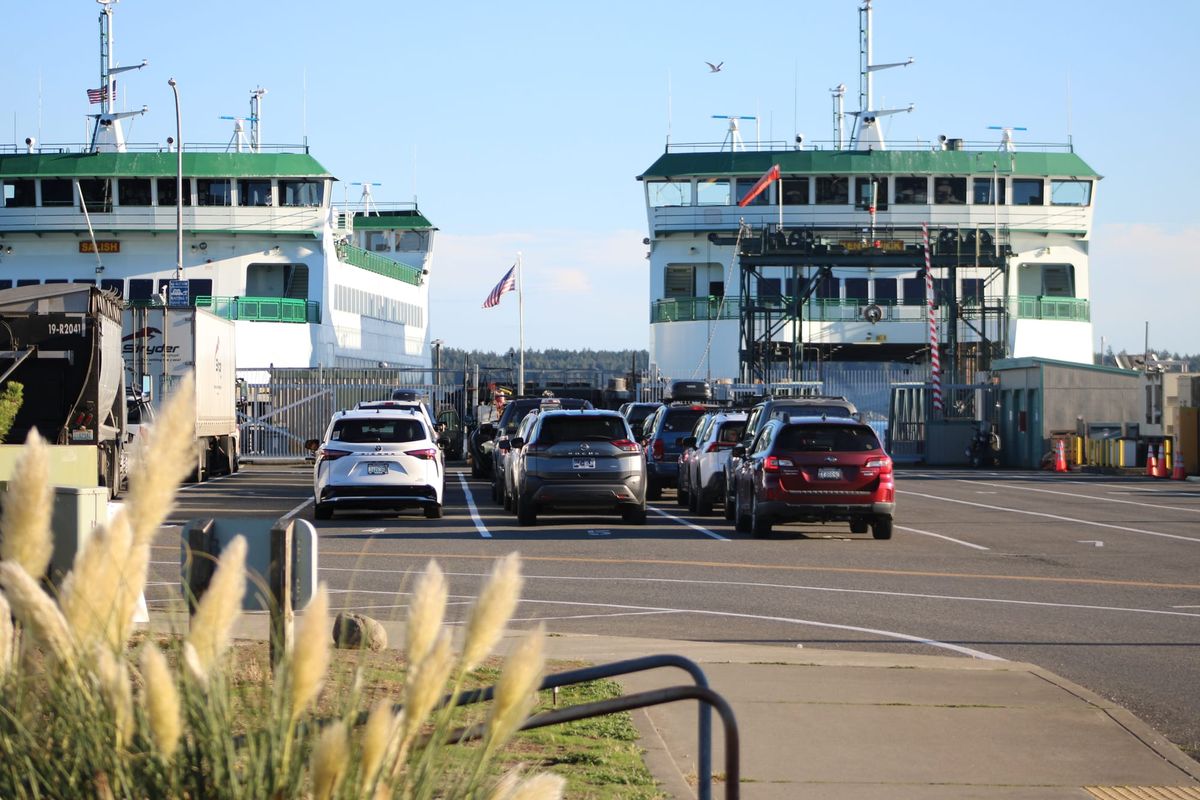
PORT TOWNSEND, WA — The #1 Kennewick ferry between Port Townsend and Coupeville was taken out of service Monday due to a shortage of crew and fog, according to the Washington State Department of Transportation, though it was one of over a dozen cancellations that rippled across the Washington State Ferries (WSF) system. By Monday afternoon, 13 of the 18 regular sailings were out of service. The widespread disruptions appeared to be a coordinated sick-out by ferry engineers as they pushed for higher wages during ongoing contract negotiations.
The chaos followed months of mounting tension between the state and the Marine Engineers' Beneficial Association (MEBA), the union representing roughly 400 engine room crewmembers and the oldest maritime trade union still in existence. In June, union representatives held a press conference to highlight unsustainable overtime demands and a roughly 20% pay disparity between engine room workers and their deck counterparts.
Eric Winge, MEBA's WSF representative, warned at the June 17 conference that the conditions causing crew shortages were unaddressed. "We will see delays and missed sailings in the summer, and unreliability will continue to be an issue if the wage gap between engineers and our deck counterparts is not closed," he stated.
The union's frustration seemingly culminated in Monday's action. While MEBA is legally prohibited from striking, a coordinated sick-out is not illegal. The union has been in negotiations with the state's Office of Financial Management (OFM), seeking a 20% pay increase to close the wage gap.
WSF statement confirms scale of disruption
In a statement released around 9:30 a.m. Monday, WSF management provided detailed confirmation of the coordinated nature of the disruptions:
"This morning, 23 engine room employees called in sick. Every employee qualified to fill those positions has declined to fill them and keep the ferries running. All of the employees calling in sick and declining to fill those vacancies are represented by the Marine Engineers' Beneficial Association (MEBA) who represent engine room employees. The ferries cannot run without these roles being filled. As a result, 13 of our 18 ferries are not in service. We understand how disruptive this is to thousands of Washingtonians. We expect our employees to return to work as soon as possible."
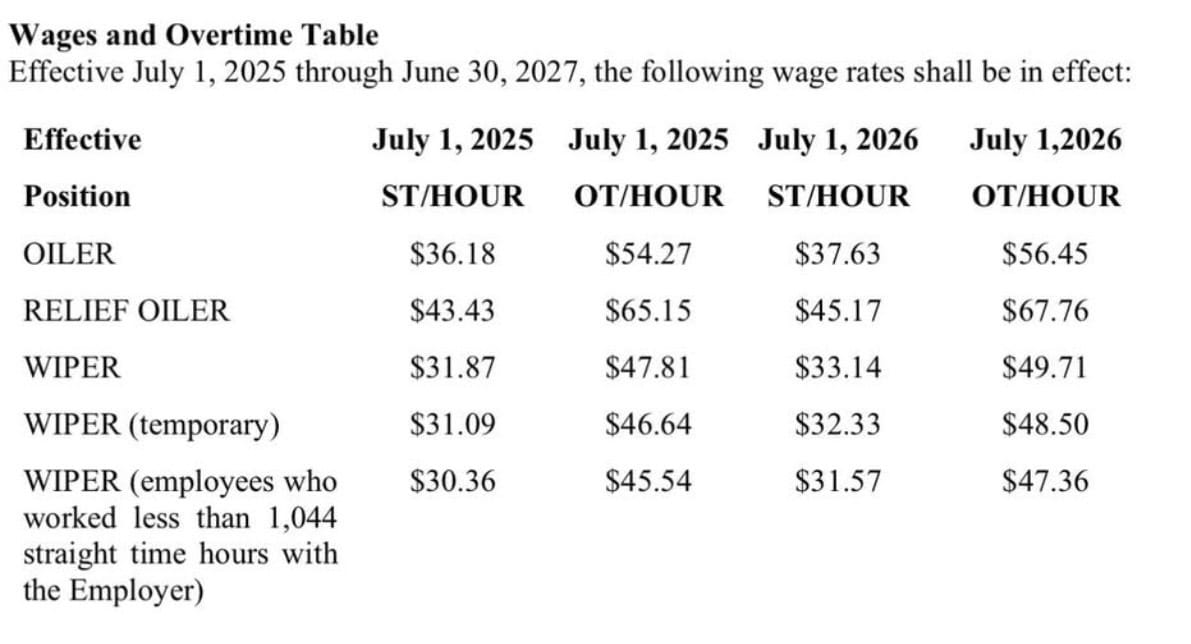
WSF then oddly included salary numbers for Staff Chief Engineers in their post, one of the highest-paid positions, saying they have “a base salary of $157,000, and can make more than $350,000 a year with overtime, as well as annual sick and vacation leave, and retirement accrual.”
Below is a current wage table for engine room positions well below Staff Chief Engineers.
MEBA responded to the WSF’s post in a statement to the USA Today Network, “Contrary to the coy implication in WSF management's social media post, today's call-ins were not initiated or aided by the Union.” Instead, they said the call-outs were a “frantic cry for help from an abused and frustrated group of highly-skilled and committed workers.”
Governor Ferguson responds
Governor Bob Ferguson addressed the crisis Monday, acknowledging the widespread impact and confirming his direct involvement:
"I met this morning with local and national MEBA union leadership. They shared their perspective on challenges facing their membership. As always, my door remains open to discussing those issues, and I remain committed to improving staffing levels.
That said, causing significant harm and inconvenience to the people of Washington state is not the way to address those issues. I was very direct in our meeting: My expectation is that every vessel on every route is fully operational no later than the first vessel sailing tomorrow morning.”
The Governor's statement signaled that the state was treating the situation as a high-level priority, though it has not yet announced a specific resolution plan or timeline.
Impact on Commuters
The impact on commuters was significant. As of Monday morning, WSF alerts confirmed that the Seattle/Bainbridge route went out of service following the 5:30 a.m. sailing, and the Edmonds/Kingston and Fauntleroy/Vashon/Southworth routes were suspended entirely due to a lack of crew. The Mukilteo/Clinton route was reduced to one-boat service, creating a two-hour wait for drivers, while the Anacortes/San Juan Islands route had multiple vessels tied up. The Seattle/Bremerton route was also on one-boat service, canceling several morning and afternoon sailings.
WSF management acknowledged the disruptions and stated it was working to fill open positions, but the scale of the cancellations suggested a significant number of engineers were unavailable.
"Washington State Ferries employees, like many workers, earn sick leave, and we honor employees' use of that leave when they are unable to work," wrote Winge in a statement. "When a crew member calls out, we work to find a qualified relief employee to fill the position so the sailing can operate safely."
The timing was critical, as a tentative agreement had to be submitted to the OFM director by October 1 for inclusion in the Governor's 2027 budget. With the current agreement set to expire in June 2027, Monday's sick-out demonstrated the worker’s leverage and the potential for continued instability if a resolution was not reached.
As of Tuesday morning, WSF updated that most routes are operating on a regular schedule, and the majority of the cancellation updates from yesterday are no longer posted on their update page.