What Happens After a Conviction for Sexual Assault
Offenders face limited rehabilitation options and the possibility of civil commitment.

JEFFERSON COUNTY, WA — The Beacon is doing a long form breakdown of what happens in and out of court for sexual assault cases. In our three part series, we’ve covered the process of prosecuting child molestation, treatment for both victims and perpetrators and now we will explore what happens after a person is convicted of sexual assault.
Though treatment at the end of a person’s sentence is considered to be effective for rehabilitation, there are high risk cases that are civilly prosecuted, often days before their release, for civil commitment.
Washington State considers sexual assault of a child to be a particularly heinous crime, and in 1990, became the first state to allow the involuntary civil commitment of convicted sex offenders after they serve their criminal sentences.
Involuntary civil commitment is, while forced, a legal process.
Because of parens patrae (parent of the country), the state is allowed to intervene and act in the best interests of individuals who cannot care for themselves. States can also involuntarily commit a person with mental illness if they are assessed to be likely to cause serious harm to self or others.
Appealing a civil commitment decision is much like other appeals; file within 30 days of the initial order, prepare a record, submit, and present at hearings. But reversing a civil commitment order for a person considered to be a sexually violent predator is difficult.
Chris Jackson, who heads the Department of Public Defense’s Sexual Offender Commitment unit, explains, “The individual’s whole life, not a specific offense, is on trial. It’s not unusual for 30 to 40 witnesses to be called or for the trial to last several weeks.”
McNeil Island is the state's Special Commitment Center, currently housing 130-200 sexually violent residents prosecuted by the Sexually Violent Predator Unit, who are responsible for 38 of Washington’s counties, not including King County.
Substitute House Bill 1133, passed in 2025, allows county prosecuting attorneys or the state attorney general access to relevant documents or records when determining if a person should be civilly committed as a sexually violent predator.
The bill closed a loophole, preventing sexually violent predators from shortening their time in custody by earning supervision compliance credits.
Individuals civilly committed at McNeil Island are also affected by the dearth of behavioral healthcare providers and often do not receive the rehabilitation needed to reenter society, effectively being warehoused on the island.
DOC reported some residents staying over two decades, after serving their conviction sentence. An estimated 125 residents have died while detained in McNeil and remain buried on the island.
Senate Bill 5854, titled Sexually Violent Predators, aims to make it more difficult for people who are at McNeil Island and do not express remorse and participate in therapy to be released. Only the sponsors of the bill do not take into consideration the lack of therapy offered.
A recent article from the Daily Chronicle reported that, “In June, The Seattle Times found the institution—which touts its purpose as providing mental health treatment to people who have committed sex crimes—had been offering as little as 90 minutes and no more than two hours of group treatment weekly for the general population. That is a fraction of what state officials and national experts consider acceptable.”
A lack of treatment options
Those convicted of sexual assault may have the freedom after serving their sentence that individuals who are civilly committed as a sexually violent predator do not, but they also face immense challenges after release based on the lack of mental health providers.
Programs like Cognitive Behavioral Therapy, a structure focusing on the connections between the patient’s thoughts, feelings and behaviors, used by the Department of Social and Human Services and the Department of Corrections (DOC), have a growing shortage of mental health workers. Funding limitations, burnout, compassion fatigue, and secondary trauma have all led to the national mental health workforce crisis. The consequences from the gaps in mental health support are compounded when considering most sexual offenders were, at one time, also a victim.
Research shows that roughly 50% to 60% of convicted sexual offenders report having been victims of sexual abuse or assault themselves, meaning not only do they rarely get support to reduce their risk of reoffending; they also do not get support to heal from their own trauma. A current study from Science Direct finds evidence that childhood sexual abuse is associated with later sexual offending and is likely the most severe form of abuse or neglect.
DOC only has enough resources to administer treatment to those individuals that are rated most likely to reoffend, meaning the majority of individuals convicted of sexual offenses are not receiving treatment, deeply affecting their life after release.
Sex Offense Treatment Assessment Program (SOTAP) through the DOC has the capacity to treat roughly 700 individuals through their custody and community programs. Yet, in June of 2024, DOC had 3,318 incarcerated individuals with a sex crime.
These therapies, while provided to only the most severe cases, are administered in the last year of an individual’s incarceration, and the first year of their reintegration into community.
Registration inequities
Freed individuals are required to register at their local police department as sex offenders, creating life-altering consequences to their reintegration; like severe lack of employment or housing opportunities, and highly restrictive laws like travel reporting and no internet. They also suffer through stigma and limitations on access to resources. These complications are amplified when individuals have not received long-term therapeutic behavioral help.
Registration and notification are not required for individuals convicted of other heinous crimes such as murder or domestic violence. Studies show that requiring sex offenders to register and notify their community of their sexual assault conviction(s) is not reducing sexual assaults.
An empirical evaluation from the University of Michigan reported, “[T]here is scant evidence that SORNA (Sex Offender Registration and Notification Act) reduces recidivism or otherwise increases public safety, with the possible exception of some tentative evidence that registration alone (i.e., without notification, which no jurisdiction currently uses) might reduce sexual offense recidivism.”
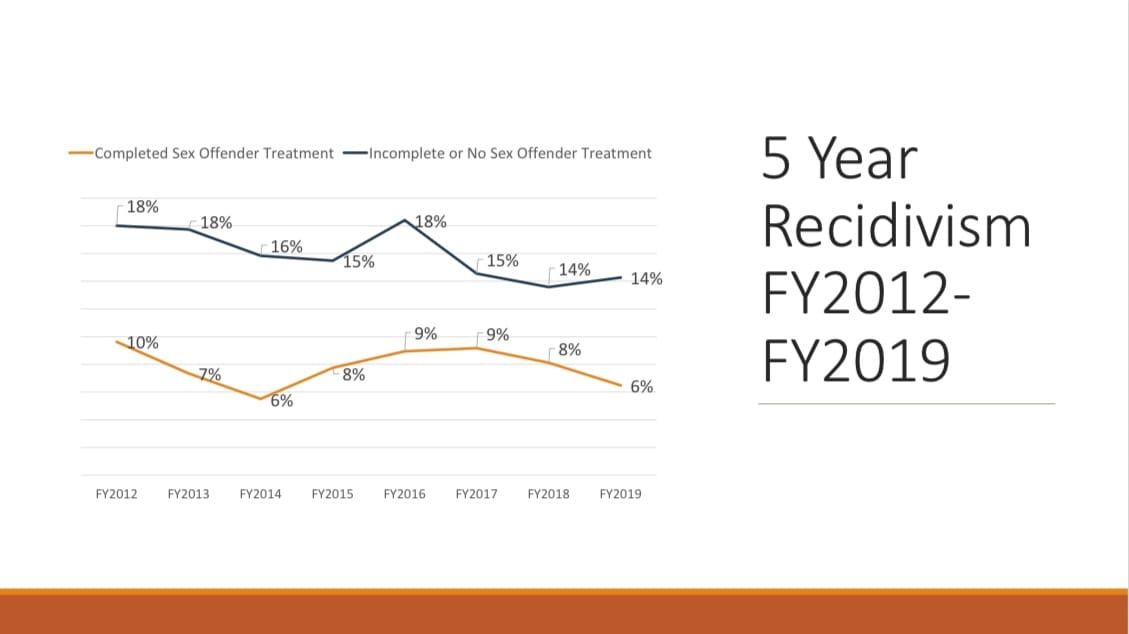
Yet, research before registration requirements showed a 45% recidivism rate decline for people convicted of sexual assault since the 1970’s. And in 2023 the DOC reported only a 7.4% recidivism rate for individuals that participated in SOTAP.
The sexual assault reoffending rate is well below that of most other crimes, especially when given the opportunity to participate in an appropriate and robust therapy program. The causal connection between childhood sexual trauma and sexual assault crimes requires that communities also hold themselves accountable, beyond just individual punishment and/or rehabilitation.
Why we are reporting on this
With several child sexual assault and incest cases currently moving through the system, and the prevalence of such crimes in rural areas, the Beacon knew it was important to report on. But the risks of reporting directly on cases are high for survivors, their families and the accused.
Informing the public of the available therapies for survivors and perpetrators of sexual assault keeps them aware of efforts to end violence in their communities and helps to alleviate stigma, encouraging conversations about societal solutions.
It is also our intention to address social bias and report on potential leadership decisions based on bias.
Where we got our information from
Our reporter exchanged emails with Elena Lopez, Director of Clinical Operations and Specialized Treatment for the DSHS’ Behavioral Health and Habilitation Administration, and Chris Wright, Communications Director of Washington State Department of Corrections.
Our approach to covering child sexual assault
The chronic nature of child sexual assault crimes reveals a need to ask questions of how the system works and where it is failing. We set out to bring light to a delicate topic in a traumatizing system, without potentially exposing victims by covering individual cases.
In our reporting we follow the legal and social history, then speak with people who have first-hand experience with how the systems in place attempt to effectuate justice. We also use this guide to ensure we’re not using language that puts blame on the victim.