Food Bank Association Seeks New Executive Director
The organization has restructured after several difficult years.


JEFFERSON COUNTY, WA — Jefferson County Food Bank Association (JCFBA) is seeking a new executive director, moving forward with a local search after a year of restructuring its governance, finance and operations. The organization's last executive director resigned in November, 2025.
“The reason that we are launching our search now is two-fold,” Mathews said. The association, she said, has a better understanding of “our own identity and our place in the community,” while also having established a stronger foundation for a new executive director.
That foundation includes new board and community committees, improved relationships with partner organizations, revised financial processes, grant-writing training and an experienced interim executive director.
Lessons from a difficult transition
The search follows a period of significant change at JCFBA. Board Vice President Sonja Mathews said in an email, "For decades, JCFBA was run by a board that included volunteer staff; the venture into a more traditional Executive Director (ED) structure was new in 2023, and there were many lessons learned.” Having the staff that the ED was supposed to be managing also on the board that in turn managed the ED created a "circular and counter-productive" situation, according to Mathews."
Mathews did not characterize those lessons learned as a list of specific personnel or governance failures. Instead, she emphasized the broader changes the organization believes were necessary to operate more effectively. One lesson, she said, was that improving internal efficiency cannot come at the expense of collaboration with other organizations serving people in need.
“Focusing on centralizing our operations for efficiency and effectiveness means our organization is able to do more with less,” Mathews said. But without stronger relationships with other organizations working in the same sphere, she said, that approach is “short sighted and ultimately defeats the purpose of our work.”
Prior to launching the search for a new Executive Director (ED), the Board of Directors took several steps to prepare, including undertaking board training, in part through hiring an experienced interim ED and updating policies and procedures by working through a checklist of non-profit best practices, Mathews said.
JCFBA hopes to have a new director by the end of 2026, though Mathews cautioned the timeline could slip if the local search doesn't produce a hire. Staff and volunteers will have a chance to weigh in before a final decision, she said, adding that it's important for candidates to understand the organization well enough to make an informed choice themselves.
Finances still recovering, with deliberate deficits
JCFBA's books have run in the red for two straight years, though Mathews characterized the shortfalls as intentional investment rather than crisis. Food costs more than doubled between 2023 and 2024—from roughly $12,000 a month to nearly $28,000—which she attributed to rising demand, tighter supply and higher prices. The organization posted a net loss of $106,211 in 2025, funded through draws on its Innovation Fund rather than day-to-day operating shortfalls. This draw paid for a warehouse and cold-storage conversion, the shift of volunteer food bank managers to paid part-time staff and additional food purchases as government-sourced food declined in both quantity and quality.
The 2026 budget calls for further Innovation Fund spending on local food purchasing, converting the organization's vehicle fleet to electric and building a new dashboard to track food distribution by location, day and hour. With Medicaid reductions expected in January 2027, Mathews said the organization anticipates client visits will keep rising—even as it aims for a balanced budget by 2027, helped along by grants including a $70,000 award this year from the Institute of Law and Systems Research.
Quilcene building's future still unsettled
The fate of JCFBA's Quilcene property remains an open question. Board President Roland Faragher-Horwell said the organization is now renting a different location with enough parking to support expanded distribution days and hours—something the JCFBA-owned Quilcene building can't accommodate. A feasibility assessment determined that relocating the building wouldn't be cost-effective, he said, and the board is now exploring alternative uses for the property in partnership with the community.
Transparency efforts already underway
The organization has also begun making changes in response to criticism over transparency during the earlier period of turmoil. Mathews said regular public reporting is already underway and will not depend on the arrival of a new executive director.
In May, JCFBA published its first annual report. The report includes information about board members, organizational highlights, finances and supporters and is available on the organization's website, with printed copies available on request. The association also began updating its website, including information about food-distribution locations and hours, current board members and how to donate.
In July, JCFBA launched its first electronic newsletter and relaunched its social-media presence. A new client-information page went online in August, providing information about eligibility, what to expect at the food bank and answers to frequently asked questions.
The association is also developing a customized operations dashboard to measure food distribution by location and hour. The system is being tested and refined during 2026.
In addition, the board is preparing a request for proposals for a professional financial audit covering the 2026 calendar year. Mathews said the audited financial statements will be made public in JCFBA's 2026 annual report, expected in spring 2027.
Looking toward growth
While the search for an executive director is the most visible next step, Mathews said JCFBA is already pursuing several longer-term initiatives.
The organization is converting its fleet of five fossil-fuel vehicles to electric vehicles. Two trucks have already been replaced with new or nearly new electric vehicles, with financial support from donors. JCFBA expects the transition to reduce expenses and improve reliability during emergencies.
The association is also trying to direct more of its food purchases toward Jefferson County farmers. In July, it began a pilot program with the Farmers Market Association to purchase food left unsold at the end of market days.
For JCFBA, the changes are ultimately intended to allow the organization to serve more people while becoming more financially and operationally resilient.
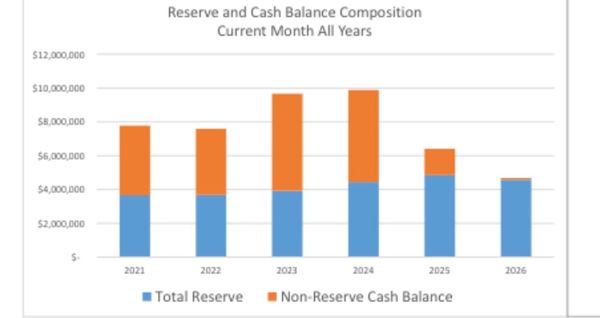
The organization says it has approximately $600,000 in a “rainy day” reserve, enough for about six months of operations, as well as a $250,000 capital reserve and approximately $900,000 in an Innovation Fund for expanding its capacity. The board has hired a professional financial adviser to manage the funds and adopted a new investment policy in July.
The next executive director will therefore inherit an organization that is simultaneously trying to consolidate the lessons of its recent restructuring and expand its reach. The challenge, Mathews said, is to make those investments translate into a sustainable operation capable of meeting what JCFBA expects will be continuing demand for food assistance in the years ahead.