Port Townsend City Council Holds Course on Comp Plan Appeal After Failed Settlement Talks
Council directs staff to develop public participation plan; approves affordable housing street vacation for Bayside Housing and emergency sewer repair.

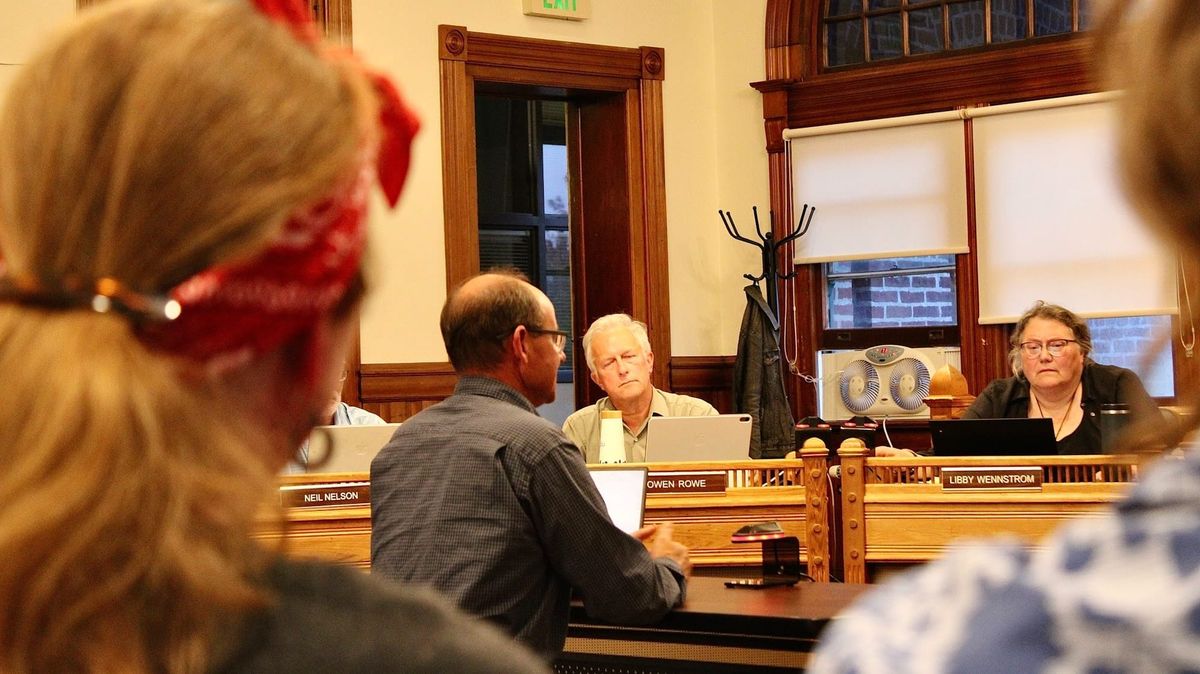
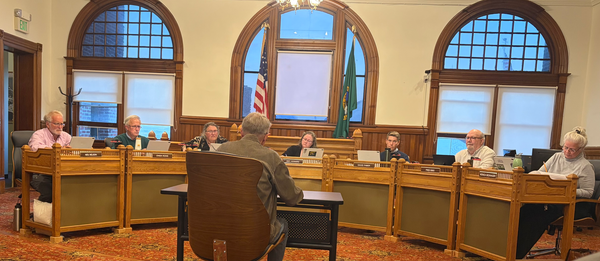
PORT TOWNSEND — The City Council voted Monday night to continue its two-track approach to the city's comprehensive plan dispute, moving forward with both the Petition for Review and a public engagement process after settlement negotiations with appellants failed to produce a joint stay agreement.
Before business began, there were three proclamations for Arbor Day, Nine to Five Day (for Dolly Parton) and Dementia Awareness Day. The Port Townsend Police Department swore in three new officers.
Interim City Manager Steve King reported that he met twice with representatives of Affordable Hometown Port Townsend (AHPT) following the council's September 8 authorization to explore common ground. While both parties found significant agreement on broad principles—including the existence of a housing crisis, the need for more density and the importance of public engagement—King said the details proved insurmountable.
"There was even an understanding that there's some density required," King said. "I think the challenge is always in the details."
The petitioners' attorney filed a response outlining AHPT's conditions for a joint stay request, but King said both parties concluded reaching agreement would be "pretty challenging." AHPT's legal counsel and the city had asked the Growth Management Hearings Board to delay ruling on the city's stay motion until September 30 to allow negotiations to continue, but those talks ultimately did not yield a joint request.
Public participation plan approved
The council unanimously approved a motion directing staff to develop a robust public participation plan, which King said must be completed before other work can proceed.
"We really need to develop a public participation element," King said. "We want to settle on that process before we even think about any other work, because that will drive the schedule and drive the workflow."
The plan will first go to the city's Equity, Access and Rights Board, then to the Planning Commission, before returning to council—a process King estimated could take several months. Council Member Monica MickHager sought clarification that the public should not expect action before the end of the year.
"It's going to be a few months from now, so that people ought not to be expecting around Christmas time," MickHager said.
Divided public comment
The council heard from numerous residents offering sharply divided perspectives on the appeal.
Kirk Rowdabaugh urged the council to "drop the legal challenge" and "partner with Affordable Hometown Port Townsend and others to amend and fix the plan."
Cynthia Koan, an 11-year member of the Jefferson County Planning Commission, asked the city to "accept the determination of the Growth Management Hearing Board," noting that "the public process will reveal" any issues with the plan.
Others supported the city's position. Jason Squire, a homeowner and lifelong service worker, said in written comment that he was "deeply offended to hear that a group called AHPT feels they speak for a majority in PT. They do not speak for me."
Cameron Jones submitted a written comment supporting the appeal, arguing that "an appeal and a public process are not mutually exclusive," and after noting the outreach through EngageJC, said, “Equity cannot mean invoking marginalized communities while discounting their input when it conflicts with your preferred policy.”
Another written comment, submitted by Aurora Kingslight, said she was “hoodwinked by the AHPT in my last public comment, thinking that they were really wanting affordable housing; it is clear that they are doing everything in their power to disrupt that, lose grant funding and misinform vulnerable people into speaking out against their own best interest.”
Council deliberation
Councilmember Libby Wennstrom pushed back on characterizations of the appeal as simply "winning or losing."
"I'm not really seeing this petition for judicial review as a question of winning or losing," Wennstrom said. "I'm seeing it as we're asking the court to clarify some things that are so unclear or so contradictory in the Growth Management Hearings Board decision that we literally can't implement."
Councilmember Fred Obee expressed frustration with the situation. "I wish there was really a good way out of this whole thing because I've been buzzing over this for some time," he said, adding that he didn't think dropping the appeal was a good alternative.
Deputy Mayor Owen Rowe noted that House Bill 1220, which introduced additional affordable housing requirements, has created challenges for cities statewide, and suggested the city could provide input to the legislature on needed fixes.
Other business
Supplemental Budget Appropriations Approved: The council approved Ordinance 3370, which includes $399,000 of projected new spending—of which most is for the remands, public process and eventual updates to the comp plan.
Street Vacation Approved: The council approved Ordinance 3371, vacating a portion of McClellan Street right-of-way between 9th and 10th Streets for Bayside Housing and Services’
Vince's Village affordable housing project. The vacation reserves a perpetual sanitary sewer easement and accepts affordable housing as value received. The project will create 32 units of affordable housing, with 13 units dedicated to households earning 30% or less of area median income and 19 units at 50% or below.
Emergency Sewer Repair: The council approved Resolution 26-018 declaring an emergency and waiving public bidding requirements to allow immediate repair of a damaged sewer line beneath Valley Trail near 3105 Sage Lane. Public Works Director Steve King described the pipe as "completely not there" in a roughly 30-foot section.
Councilmember David Faber noted the broader infrastructure implications, stating that the city's low density creates an insufficient tax base to maintain its extensive infrastructure. "We actually need to fix the more fundamental problem, which is insufficient tax base to pay for our sprawl infrastructure," he said.