Port Townsend School District Navigates Choppy Financial Waters
A successful school construction bond and nimble operational steps keep the district on solid financial footing.


PORT TOWNSEND, WA — As Port Townsend School District’s students and staff enter the second week of the 2026–27 school year, the district is preparing for a substantial makeover of its high school campus. The $108 million project is now in the design phase, with construction slated to begin next year. While the district grapples with reduced state and federal funding, it also faces rapidly increasing costs for utilities and insurance.
The improvements include safety, seismic upgrades and modernization at the historic Port Townsend High School, plus renovations and additions to the Gael Stuart Building. The Gael Stuart Building will become a permanent home for OCEAN K-12 Alternative School, as OCEAN’s classrooms are currently in portables behind Blue Heron Middle School.
Also on the horizon for the high school campus, is an early learning center to be constructed next year to serve infants through age four.
The work schedule targets the completion of the main high school building for early 2028, and completion in 2029 of an addition that will connect the main high school building with the building that will house the gym, shops, and arts. Occupancy of the OCEAN School is scheduled for Fall 2029.
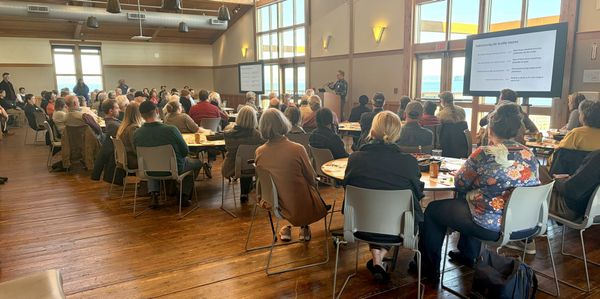
The district held design sessions over the summer, at which over 100 people attended. Rosenberry said that various changes were made to the campus and buildings design as a result of session input, such as making the entire campus more wheelchair accessible.
The work will be overseen by David Arp, who was recently hired as PTSD’s Director of Finance, Business and Operations. Arp is replacing Amy Khile, who is retiring after 12 1/2 years in the position. Arp brings experience of working in school districts similar in size to Port Townsend.
Funding of the $108 million project comes mostly from a $99.25 million bond measure that was approved by Port Townsend voters on February 10th, 2026.
Financial footing is challenging but stable
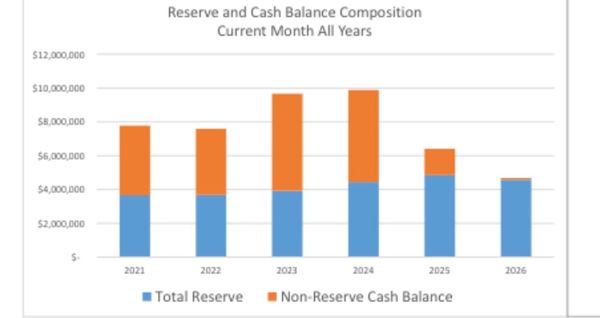
Despite the rising financial challenges in recent years, Khile is leaving a district that is in better financial condition than when she arrived. Early in her tenure, the district's general fund balance was $400,000. Now it is $3.1 million.
Perhaps more important, is that the district has a Moody's Rating bond rating of A2, a high-level rating that enables it to borrow money at lower interest rates than many school districts with lower bond ratings. Moody’s Rating assigns letter grades to default risk and creditworthiness of debt issuers.
The district’s 2026-27 budget projects $25.5 million in general fund revenue and $26.97 million in expenditures. Its ending fund balance is projected at $2.2 million.
The district has a $964,000 budget deficit, but expects to maintain an ending fund balance of $2.1 million, which barely meets the board's 8% reserve requirement.
“I think this four-year budget shows what would happen if we didn't make any major cuts,” PTSD Superintendent Linda Rosenbury said. “And I don't think the school board would approve an annual operating budget that didn't maintain their policy of at least 8% fund balance. So while this shows what would happen if we maintain the same level of staffing, we can't eat into our reserves every year. We are optimistic that this coming year; our enrollment will be above our projections, some of our expenses will be below.”
Rosenberry said that enrollment is getting a little boost due to families moving into the new Madrona Ridge development.
Reduced state funding forces cutbacks
Public schools in Washington receive funding based on how many students are enrolled. Rosenberry said that 43.1% of the state's general fund balance is directed to education, down from 52.4% just 5 years ago. The decreased funding, coupled with rising cost pressures, are forcing the district to make uncomfortable decisions.
The school board approved its teachers’ contract last week that Rosenberry said, “maintains competitive wages that are more modest than in previous years. We're grateful that our labor partners recognize this financial stress, and we're able to come to an agreement on something that the budget can manage.”
Another step that the district has taken to save money is to transition from separate teachers for band and orchestra to a single teacher for both at the middle and high school levels.
Rosenberry added that the community is pitching in, with some families beginning to pay tuition for the Transition to Kindergarten program for 4-year-olds. The state cut $180,000 from that PTSD program.
The state also made substantial cuts to PTSD's outdoor learning programs for 5th and 6th graders.
Jefferson County has cut funding for mental health therapists in the Quilcene, Chimacum and Port Townsend school districts. Rosenberry said that PTSD will attempt to fill in the gap by asking the Jefferson Community Foundation to include mental health therapists for the schools in their United Giving Neighbors program this fall.
During construction, the district administration staff have vacated their office at the Gael Stuart Building, which will become a main office and classrooms. That staff is now housed at offices at the Boat Haven.
“We're also partnering with Fort Worden and Wheeler Theater for performances with our musical program, our theater program and our music program,” Rosenbury said.
Progress of the entire construction project will be posted regularly and viewable online at: https://www.ptschools.org/page/bondprogress