Port Townsend’s City Manager Pay
Past debt and the road ahead: An in-depth analysis of John Mauro’s salary and potential departure.

PORT TOWNSEND, WA — A debate over a 3% raise for Port Townsend City Manager John Mauro has opened a wider public conversation about executive pay, the city’s financial past and the tangible results of a shift toward long-term fiscal sustainability. Mauro’s annual salary now stands at $251,640, following the raise approved by the City Council on June 1, 2026. This compensation has drawn scrutiny from some residents who compare it to the governor’s salary or point to the city’s modest population and comparatively low median income. However, an examination of Mauro’s pay relative to his professional peers, the city’s history of debt and deferred maintenance and the major infrastructure projects now underway under his leadership combine to reveal a more complex picture.
The salary debate: Market rate vs. public perception
The conversation about Mauro’s pay often begins with a misleading comparison. Critics frequently point out that Governor Ferguson’s annual salary will be $234,275 on July 1, which is $17,365 less than Mauro’s. However, this comparison rarely accounts for the full compensation package afforded to the Governor, which includes significant non-salary perks that a City Manager does not receive. The Governor resides in the official executive mansion in Olympia, a historic property maintained at state expense. His job includes a dedicated state patrol security detail, a large staff and other official allowances for travel and entertainment.
Beyond these tangible differences, Council member David Faber explained during the June 1 council meeting that elected officials, such as governors and city council members, are almost always paid far less than the professional executive staff who manage complex operations. Faber noted that the governor is not even among the top 100 highest-paid state employees, highlighting that the market for professional city management normally commands much higher compensation. As Mayor Amy Howard succinctly put it during the same meeting, “Anybody can get elected,” underscoring the distinction between winning a public vote and having the skills and experience to perform a demanding professional role. While Mauro’s new salary is indeed higher, the roles of an elected official and a professional administrator are fundamentally different.
When measured against his professional peers, Mauro’s salary is not an outlier. After his 2025 and 2026 raises, Mauro’s pay sits near or slightly above that of most Washington State city managers. Statewide data shows that the average Washington city manager earned $219,432 and the top ten percent earned over $367,868. In January 2026, the Vancouver City Manager’s salary was raised to $348,245, which is the highest paid city manager in the state. Mauro’s pay is well within the competitive range for experienced City Management professionals.
Council members defended the raise not only as market-competitive but as a retention necessity. Council Member Neil Nelson stated publicly that replacing Mauro would be “extremely difficult” and that the city is “getting our money’s worth.” Mauro’s contract requires an annual raise upon a positive performance evaluation; the 2026 raise mirrored the 3% increase given to all other senior city staff, maintaining parity. Crucially, both the Council and Mauro point to the city’s financial turnaround and major grant successes as justification for the investment.
A history of borrowing and strain
To understand Mauro’s tenure, one must first understand Port Townsend's financial condition when he was hired in 2019. The city had spent the previous decade accumulating significant debt, largely for infrastructure projects. Between 2010 and 2017, Port Townsend issued several rounds of general obligation bonds, including a $3.74 million bond for sidewalks, utilities, and the Carnegie Library retrofit in 2010, and voter-approved unlimited tax bonds for energy retrofits at Mountain View Commons in 2015.
A 2011 state auditor’s report warned that Port Townsend was “at risk of not being able to meet financial obligations at current service levels.” The city’s general fund balance had plummeted from $258,408 in 2006 to just $915 in 2009, recovering only slightly to $40,930 by 2010. By 2019, the situation had become critical. A city report revealed that expenditures were outpacing revenues by 14% annually, and major funds were projected to go negative by 2025. Debt from city council-approved projects required approximately $1.7 million in annual payments, consuming 10.9% of the city’s revenue and climbing closer to its self-imposed fifteen percent limit.
Mauro acknowledged this legacy in an interview, noting that the city is still paying off debt from projects that were completed well over a decade ago, like the improvements to Water Street. He characterized debt service as an “opportunity cost” that diverts funds from current needs. Rather than continuing to borrow, after 2020, Mauro and the council deliberately chose to take on no new operating debt—a 2020 refinancing capitalized on lower interest rates and generated over $500,000 in savings.
No deputy manager: A deliberate trade-off
One of the most significant structural choices under Mauro’s leadership has been the decision to operate without a deputy or assistant city manager, roles which are common in comparable cities.
Instead of a deputy, Mauro relies on a team of eight department directors, whom he calls his “dream team.” Each director is capable of stepping into aspects of his role if he is absent, a structure he believes saves taxpayer money while building a resilient leadership culture.
He has also invested in other positions over time, including adding a communications and marketing director and reorganizing what had been his predecessor’s executive assistant role into a public service front-desk team. This lean executive structure is presented as a conscious trade-off: accepting public scrutiny of his salary in exchange for taking on a more significant leadership role and directing resources toward staff and City projects.
Mauro confirmed that most cities of this size have a number-two executive, often the second-highest paid position. He explained that he’s intentionally chosen to forgo that role, stating, “I’d rather have the community snipe about how much I get paid . . . and use that money to make sure that our team is supported. I’ll just work harder.”
The TBD and the road to catching up
The most visible result of Mauro’s financial strategy is the Transportation Benefit District, or TBD, approved by nearly eighty percent of voters in November 2023. This measure created a dedicated local funding source for street repair by adding a 0.3% sales tax, set to expire in ten years unless terminated earlier by the Council. The TBD is expected to generate an estimated $1 million annually and, in its first partial year from April to December 2024, collected $731,985, significantly exceeding expectations.
The TBD was born from necessity. State funding for city and county streets has declined since 2000, leaving Port Townsend’s eighty-mile street system in what Mauro described as an “unsustainable” condition. He recalled that when he first interviewed for the job, he was struck by how bad the streets had become, a sentiment echoed by a visiting exchange student who bluntly told him the streets were “terrible.” Rather than asking voters for a general levy lid lift, the city proposed a targeted, voter-approved sales tax specifically for streets.
The TBD is structured to serve three main purposes. Forty to sixty percent of its revenue goes directly to pavement repair, rehabilitation, and preservation. Twenty to forty percent is used as matching funds to leverage state and federal grants, turning local dollars into millions in outside funding. The remaining 10 to 20% is dedicated to sidewalks, ADA upgrades and neighborhood traffic calming.
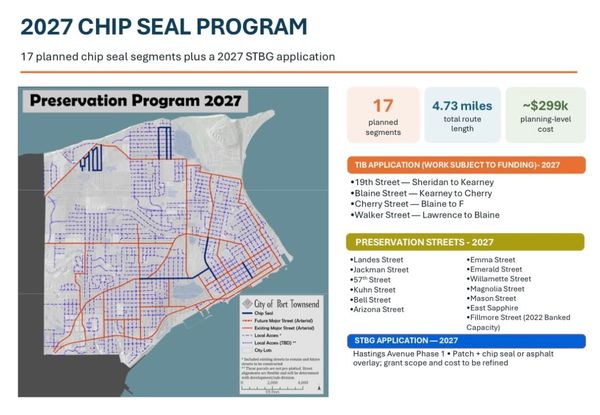
The results are already visible. The Lawrence Street Multimodal Project, a full reconstruction of six blocks including pavement, sub-grade, sidewalks and utility upgrades with a total budget of $4.1 million, is being supported by a $2.99 million state grant. The city’s match includes $475,000 from TBD funds. For the 2026 construction season, the city has planned an 8.5 mile street preservation program covering twenty-four roads, including chip sealing, drainage work and hot spot repairs. This work is being done in partnership with Jefferson County, which provides cheaper chip-seal equipment, creating a “win-win” for both agencies.
Other TBD-funded projects include the Discovery Road Bikeway and Sidewalk Project, hot-spot pavement repairs on Mill Road and San Juan Avenue, and a chip-seal project on F Street and San Juan Avenue, which was supported by a $260,000 grant.
Mauro noted that the TBD also sends a powerful signal to state funding agencies. When the state sees that a community has committed its own stable source of funding, the state is more willing to contribute. As Mauro put it, “The state knows that we’ve got voters who want this, and we’ve also got a steady source of funding.”
Catching up after years of deferral
Mauro is candid about the scale of the remaining challenges. He described the city as having “so much to catch up on” across streets, facilities, fleets, parks and housing. The city has established a dedicated “piggy bank” fund for fleet vehicle replacement, which is now in its third year. For facility maintenance, a new program is being set up to plan ahead to avoid surprise costs, such as the $100,000 roof repair at Mountain View Commons that caught the city off guard two years ago.
On affordable housing, the need is even more staggering. The city estimates it would require $17 million annually to adequately subsidize housing at all levels, a figure that exceeds the entire general fund budget. Mauro noted that even if the city stopped funding core services like police and planning, it would still be unable to meet that need. The council is currently exploring creative options, including cross-subsidies from market-rate housing, but the mechanisms for 2027 remain under discussion.
Mauro summarized the city’s predicament with a metaphor: “They say the best time to plant a tree was thirty years ago, and the second best time is right now. Same thing with infrastructure investment.” He acknowledged that Port Townsend is not alone in this struggle.
As vice-chairman of the state association of cities, Mauro talks to colleagues across Washington who face the same regressive tax system and legacy of deferred maintenance. But he doesn’t see that shared struggle as an excuse for complacency. Instead, he points to the city’s growing list of accomplishments under his leadership, including its first-ever Government Finance Officers Association Distinguished Budget Presentation Award in 2026, a clean state audit history, and the financial stability that allowed the council to approve raises for staff across the board.
Other awards include Local Government Excellence in Community Sustainability and Strategic Leadership & Governance Awards from the International City/County Management Association and a Municipal Excellence Award from the Association of Washington Cities, among others.
A sudden departure potentially threatens progress
The news that Mauro is a finalist for the Bainbridge Island city manager position fundamentally alters the stakes of the salary discussion. Bainbridge Island, with a population of approximately 24,500 and a median household income exceeding $150,000, is a wealthier and larger community than Port Townsend. The salary range for the position is listed as dependent on qualifications, though the proposed market-based range in the city’s FY26 budget was $168,214 to $213,662, notably lower than Mauro’s current Port Townsend salary of $251,640. This suggests that factors beyond compensation may be motivating his interest.
Public events are scheduled for June 17, 2026, where Bainbridge Island residents will have the opportunity to meet both finalists, Mauro and Jeff Niten, the current city manager of Mountlake Terrace. If Mauro is selected, his departure from Port Townsend could be swift.
The timing is striking. Just two weeks after the Port Townsend City Council unanimously approved his raise and praised his leadership as indispensable, the council now faces the very real prospect of a sudden vacancy at the top. Council Member Nelson’s warning that replacing Mauro would be “extremely difficult” now reads as prescient rather than merely explanatory.
The cost of a sudden departure could be substantial. The city would likely need to launch an immediate, expensive and competitive search for a new city manager, potentially involving an executive search firm with fees reaching tens of thousands of dollars.
Investing in resilience
The debate over Mauro’s 3% raise is ultimately about more than a single salary. It is about whether Port Townsend is getting value for its investment in professional leadership. The evidence suggests that, after years of accruing debt and deferring maintenance, under Mauro’s leadership the city has stabilized its finances, taken on no new operating debt since 2020, and created sustainable funding mechanisms for the first time in a generation to begin tackling its most visible failing: its streets. Whether residents ultimately judge his pay to be too high or entirely justified may depend on whether they see the crumbling streets being rebuilt and the financial awards being won as the result of Mauro’s leadership, or as long-overdue progress that should have happened regardless of who was at the helm.
Now, that investment is at risk of walking out the door. Whether Mauro stays or goes, the council’s unanimous vote to approve his raise and their public statements about the difficulty of replacing him will be remembered as either a prudent retention strategy that came too late, or as the final act of a leader whose departure was already in motion. The residents of Port Townsend, who approved the Transportation Benefit District by nearly eighty percent and have watched their streets begin to improve, will soon learn whether the manager who led that turnaround will be there to finish the job.
Why we are covering this
Readers asked the Beacon to look into whether Mauro’s salary, and recent raise, is a justifiable city expense. With many local people struggling to make ends meet, and with the complex ways a government employee is compensated, we chose to create an explainer that acknowledged the complexities of remuneration, showed the challenges Port Townsend faces and found ways to measure how the city manager is addressing those specific issues within the matrix other city managers are evaluated by.
These findings do not mean there isn’t a need for additional conversations about wealth inequality in our county.
How we are covering this story
We used historical data, budget documents, awards, current comparable salaries in the state and a direct interview with John Mauro.