Port Townsend City Council Discussed Growth Management Remand and Appeal
Council also adopted the first reading of the 2027 budget and heard a presentation from the Friends of the Camas Prairie Golf Park.

PORT TOWNSEND, WA — City Council met for four and a half hours on November 16, moving through a 2027 budget adoption, a presentation from the Friends of the Camas Prairie Golf Park, a work plan responding to the state growth-management ruling, affordable housing funding and a contentious debate over the city's appeal—punctuated by public commenters and council members accusing a local homeowner group of acting in bad faith.
Budget’s first reading adopted
The council approved the first reading of Ordinance 3373, the city's 2027 budget. Finance Director Jodi Adams said the operating general fund is balanced, with reserves ending at about $2.9 million, above the city's target, after late cleanup items added about $20,000. The budget adds three new permanent full-time positions and two temporary ones. Final adoption is expected December 7.
Officials also clarified that the Mountain View pool is not closing, after several residents, including members of the high school swim team, spoke in its support. What the general budget does not do is begin pre-funding a repair-and-replacement reserve for the aging facility, given uncertainty over the city's long-term relationship with the school district-owned campus and a potential county pool. Catastrophic repairs would return to council. "We're not closing Mountain View. We're not closing the pool," Adams said. The 2027 budget still includes $376,936 for operations at the Mountain View facility.
Golf park group seeks housing provision removal for $1M grant
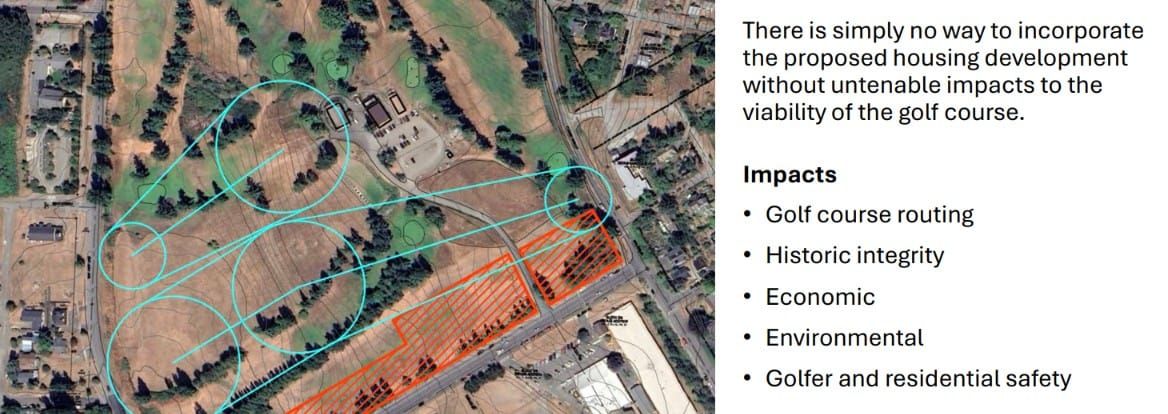
The Friends of the Camas Prairie Golf Park presented a master use plan developed with golf architect Mike McCartan, envisioning a putting course, playground, event space and expanded programming. McCartan said incorporating the lease's proposed housing would require a wholesale redesign and jeopardize the course. The Friends have raised more than $1 million, including a grant from the Camilla Chandler Family Foundation conditioned on the city removing the housing provision from the golf park lease.
Councilmember Fred Obee called it "an easy choice" since the city would retain ownership while attracting private investment. No action was taken; lease changes are expected back before the council in early February.
Remand work plan and costs
After waiving attorney-client privilege from a November 9 executive session, City Council and staff discussed the GMHB remand appeal publicly.
Planning Director Emma Bolin outlined a four-part remand work plan—public participation, housing, capital facilities and transportation—responding to the Growth Management Hearings Board's final decision order. She corrected what she called a recurring misconception: the board's public participation finding applied specifically to the R-II sixplex amendment, not the entire comprehensive plan.
City Attorney Austin Watkins broke down legal costs: about $61,525 in-house for defending the original AHPT appeal (already completed); about $185,000 estimated for non-discretionary remand work; and about $116,000 for the discretionary judicial appeal, of which roughly $35,000 has been spent.
The council authorized up to $300,000 in professional services agreements—$200,000 from the 2026 budget and $100,000 from 2027—to address the remand issues unrelated to legal costs. Councilmembers noted the figure is a floor, not a ceiling.
Appeal debate turns heated
The appeal discussion drew sharp public comment—and several moments where AHPT representatives were corrected on the record.
Resident Devin Gonzalez submitted a petition with 115 signatures stating that AHPT does not represent them. He criticized the group's petitioners—John Watts, Todd McGuire, John Capps and Mary McCurdy—as high-end homeowners in R-II zones whose properties, according to Zillow, are now worth roughly $6.7 million. "Yet these homeowners, along with Seattle-based attorney Judy Krebs, are opposing efforts to move affordable housing forward in their neighborhoods," he said. "Meanwhile, working families are being displaced, rental homes are being sold and the people who keep Port Townsend running can no longer afford to live here." Gonzales also criticized Councilmember Obee for “joking about a million dollars for the golf course, while working families struggle to find affordable housing.”
Judy Krebs asked whether the budget omitted a fund-balance analysis under RCW 35A.33.075, which does not mandate such analysis. Adams corrected her: the fund-balance requirement applies to the preliminary budget—figures presented October 19—while the adopted budget contains revenues and expenditures. Krebs also suggested the city had removed $100,000 allocated for the pool. Bolin clarified that the pool's facilities funding had been moved into a new facilities ER&R (Equipment, Rental and Revolving) fund, not cut.
Mary McCurdy asked how a $450,000 legal figure mentioned at the November 2 meeting squared with the appeal's cost. Watkins corrected the record directly: "I don't know where that number came from . . . I can unequivocally say that is not the cost of this appeal." He put the appeal cost at $116,400. The November 2 figure that McCurdy was referring to was a total including appeal and planning costs, not solely legal costs. McCurdy also asked whether it was legal to have potential expenses unfunded; Bolin said she was not aware of any legal restriction, noting the city has multiple opportunities to amend the budget.
John Watts, AHPT president, offered a joint stay request if the City dropped its appeal. Watkins explained this was not possible, and at the November 17 press conference was more emphatic: "The court does not have authority under the Administrative Procedure Act, nor does the Growth Management Hearings Board under the regulations or the APA to issue a stay without a pending judicial appeal." If the appeal is dropped, he said, any stay is dropped with it. He also noted AHPT's position on seeking clarification had shifted—first insisting the city could not seek it and threatening more litigation if the City tried, then later suggesting it should. Watts also said, “Our appeal was only directed at the process around the last minute upzone in the R-II.”
Faber called Watts's claim that AHPT’s appeal concerned only the R-II amendment "absolutely mystifying," noting the appeal included parking minimums, daylight plane setbacks and capital facilities planning. Wennstrom called the appeal characterization "active disinformation," echoed by Deputy Mayor Owen Rowe, who pointed to a written comment from AHPT member John Capps claiming the City's objective was to avoid the remand work. "That is not our objective," Rowe said. "That is acting in bad faith." Mayor Howard pointed out AHPT had appealed 13 items, calling Watt’s claim "disingenuous." The City explained that the FDO’s invalidation of the “other related elements” goes beyond the R-II zone density increases.
Habitat for Humanity Executive Director Jamie Maciejewski asked that the two parties work together to “unfreeze” R-III and R-IV, focusing compliance on R-II, seeking an extension past February 2027 and pausing the appeal. But that path depends on AHPT's cooperation—the city cannot obtain a stay without AHPT joining the request. Maciejewski's proposal, however well received, was not something the city could act on unilaterally.
Watkins outlined why the Council chose to pursue the appeal: preserving legal options during compliance hearings and seeking statewide clarity on HB 1220, the eight-year capital facilities requirement in the FDO that contradicts the GMA’s six-year requirement and the board's invalidity authority. He cited Orca Nexus v. City of Seattle, a September 9 Growth Board decision that referenced Port Townsend's case on racially disparate impacts—evidence the issues carry statewide stakes. No vote was taken, as the City had not changed its course; the discussion was left open for AHPT to reasonably work with the City. "Please work with us and do not try and dictate outcomes," Faber said.
Other business
The council approved a state-mandated business and occupation tax code update, deferred building and utility connection fees for the Bayside Housing’s Vince’s Village Project and voted to seek an external recruiter with extensive community engagement for the city manager search.