Partnership Leads to Completion of Pedersen Nearshore Restoration Project
The North Olympic Salmon Coalition marks another significant milestone in the recovery of summer chum salmon in Discovery Bay.

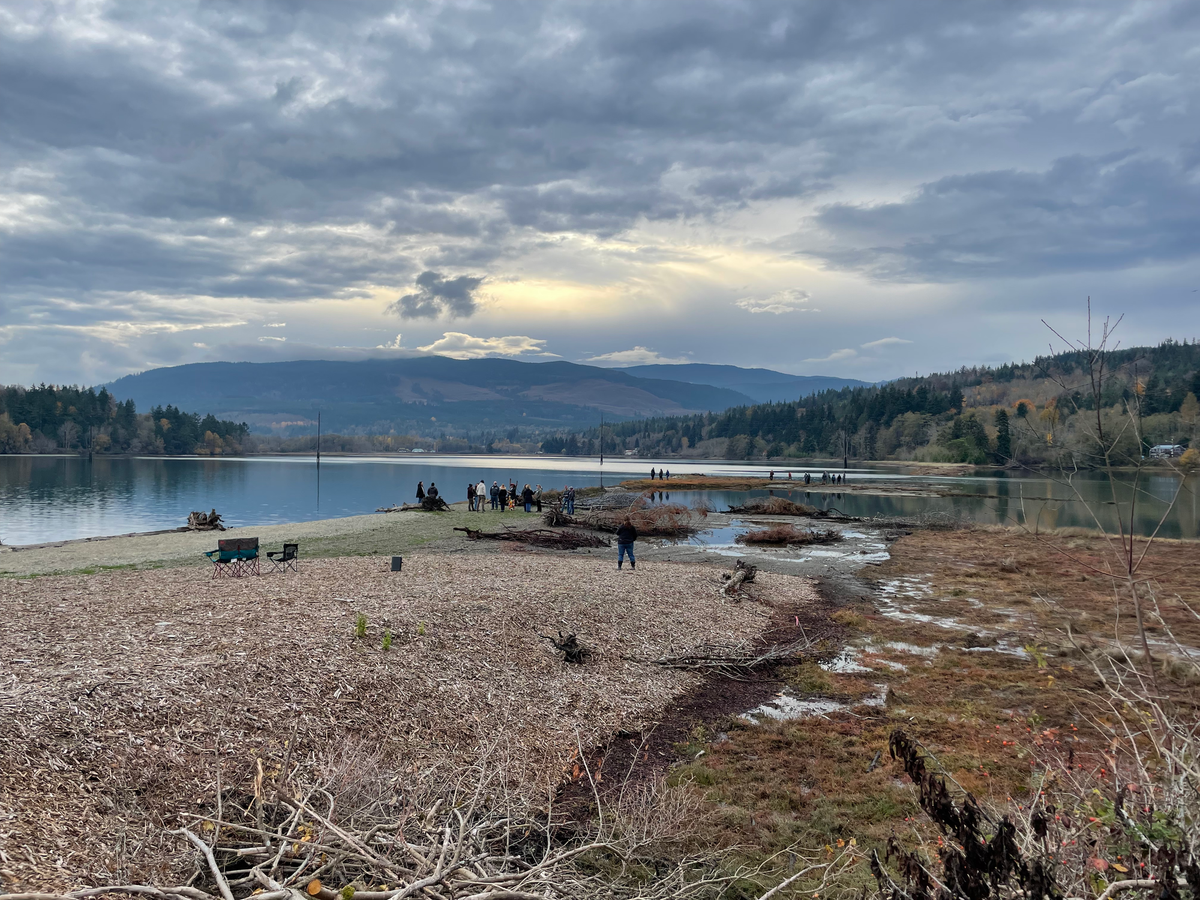
JEFFERSON COUNTY, WA — A celebratory atmosphere filled the salty air on Wednesday, November 4, as the North Olympic Salmon Coalition (NOSC), along with partners like the Jefferson Land Trust and the Jamestown S’Klallam, celebrated the completion of the Pedersen Nearshore Restoration project. Twenty-five years after conservation work began in Discovery Bay, and over a hundred since the land was initially developed, the spit on the western shore of the bay finally looks much like it would have when the Jamestown S’Klallam had villages along its shores.
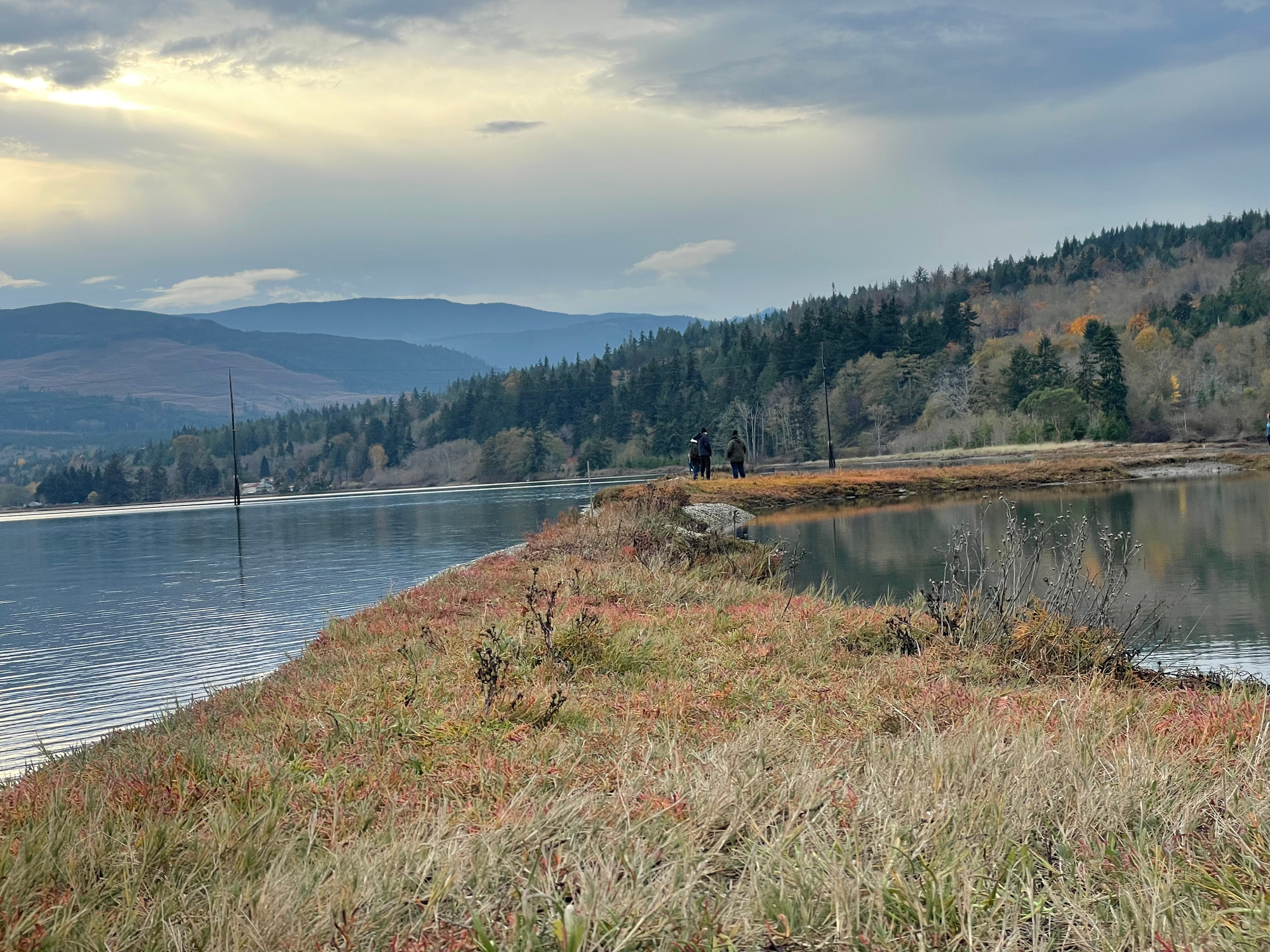
Looking south from the spit towards the tip of Discovery Bay, there’s no evidence of the cabin and railroad grade that were built in the early 1900s. During that development boom, spit and salt marsh complexes were often graded and filled to make even more room for buildings and railroads, leading to significant loss of habitat for fish and wildlife. In Discovery Bay, this particularly impacted Endangered Species Act-listed summer chum salmon. When the railroad grade ran through, the ground was raised by 7-8 feet and a retaining wall was built along the shoreline to protect a waterfront cabin from wave action and erosion.
Since work began this summer, over 2,000 cubic yards of fill was removed from the beaches and salt marshes. Along with the cabin itself, 260 feet of bulkhead and 440 feet of abandoned railroad were removed, allowing for thorough restoration of the shoreline. A small dock was also removed. Kevin Long, Senior Project Manager with NOSC, said salmon are known to dislike swimming under over-water structures. Cumulatively, this work restores the natural flow of the salt marsh and rehabilitates critical habitat for summer chum salmon—part of an ongoing effort for the species and one that is slowly paying off. “They are on the cusp of delisting from the Endangered Species Act, potentially the first salmon to be delisted,” said Sarah Doyle, Executive Director of NOSC. “They are still doing a lot of research on the parameters, because of the changing climate, to make sure it is viable. But we are hitting a milestone of recovery for summer chum salmon. And some of that is because of all this work.”
For Loni Greninger, Vice Chair of the Jamestown S’Klallam, the project was an ideal example of how conservation efforts can deal with cultural resources from a tribal perspective. The spit is close to two known village sites along Discovery Bay, occupied by the tribe up until the late 1800s, when railroad history came through and changed the landscape for people and animals. “Early and often consultation with the tribes,” Greninger said, describing how to bring them into restoration work. “It helps us to avoid disturbing cultural resources where possible. And consider, when we do need to, how do we do that effectively, in a way that helps the tribe and the project the most.” The site included shell midden, piles of old shell and bones discarded after meals or potlaches. Often, this layer can be deeper than the beach itself and contain important artifacts. Prior to any restoration work, they did shovel probes and delineated boundaries to avoid the deepest parts of the midden. In addition to fish and mammal bones, they also recovered some items for the tribe’s collection, including an adze blade for carving, a ground slate blade and fire-cracked rock.
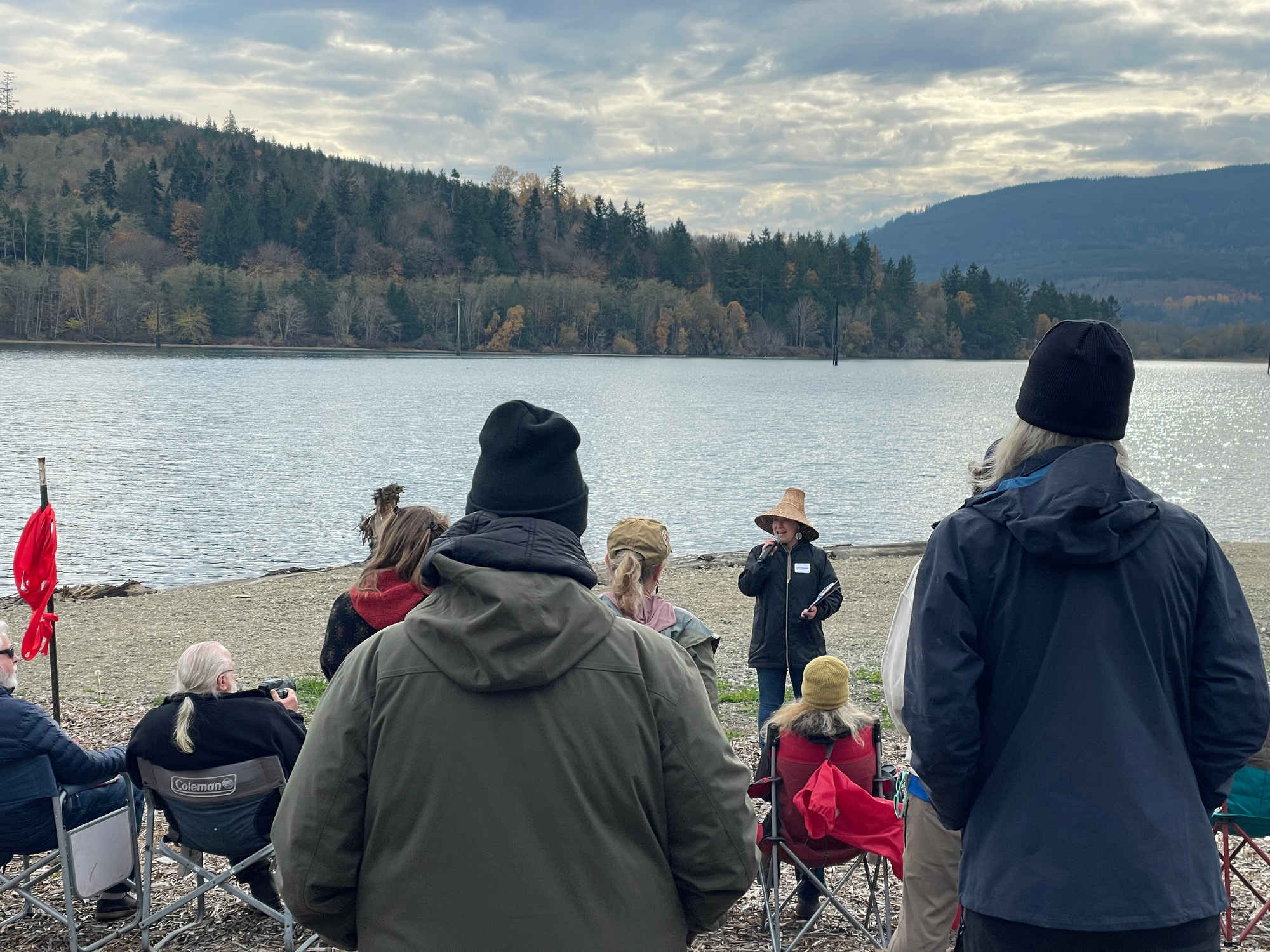
The project was able to break ground when the Jefferson Land Trust, thanks to grant funding, acquired several properties in the area, including the one-acre Pedersen property, allowing for NOSC project managers to access the site and begin imagining the restoration possibilities. Sarah Spaeth, Director of Conservation and Strategic Partnerships with the Jefferson Land Trust, emphasized the importance of partnerships to restoration projects in Discovery Bay and the surrounding areas. The Land Trust can only acquire land from willing landowners, and patience is the name of the game; sometimes it takes years of conversations for landowners to be ready to sell.
After acquisition, good neighbors can really help the process. In this case, the MacLeod family owned the adjacent property and worked collaboratively with the Land Trust, the tribe and NOSC to facilitate access to the site and provide historical information about the buildings. They also owned the creosote bulkhead that was removed. Three of the children of Betty Cooper-MacLeod were present at the ribbon-cutting. “The family involvement with Discovery Bay starts about 1881, when George Cooper and family moved from Dungeness,” said Allan MacLeod. He put together a packet of photographs showing how the land had evolved since the railroad was built. “I feel a sense of satisfaction,” MacLeod said, when reflecting on the end of the project. “Nobody was using the cabin down here.”
Doyle talked about the historical aspect of this project as something that would stick with her. “It’s a powerful legacy moment,” she said. “We’ve brought this habitat back, and the view we have right now is looking out upon years of work. I wish we had a digital slide to show it. Because when you look here now, you just don’t know everything that has been removed. Now it’s just this beautiful scene that we know is a healthy, thriving habitat for salmon."