Port Townsend Council Navigates Water Rights Confusion and Approves New Leadership Structure
Code violation settlement results in extended affordable housing and safety planning for school-adjacent streets discussed.


PORT TOWNSEND, WA — City Council convened on August 3, 2026, for a marathon meeting that delved into some of the city’s most complex and consequential issues. While the evening began with routine business and a discussion on road safety, the bulk of the nearly four-hour session was consumed by two major topics: a deeply confusing debate over municipal water rights for agriculture, and a decisive vote to restructure the city’s top leadership.
Settlement preserves affordable housing at Norwest Village
The meeting opened with a resolution to settle a long-standing code enforcement case against Norwest Village, a property owned by Catholic Charities of Eastern Washington. Staff reported that the property had accumulated over $125,000 in penalties for various safety and public nuisance violations. The proposed settlement waived the remaining balance in exchange for a commitment to correct all violations and ensure the property continues to serve as affordable housing for at least three years.
Jonathan Mallahan, the executive director of Catholic Charities, joined the meeting online to assure the council that the organization’s mission is to keep the units affordable long-term, despite the three-year contractual period. Councilmember David Faber expressed cautious support, stating he would "be on the lookout to make sure that we aren't being fooled in making this decision." At the same time, other members praised staff for their work on the negotiated agreement, and the settlement was approved unanimously. Mayor Amy Howard noted that “the safety and dignity of people who live in affordable housing is paramount.”
Road striping options favor pedestrian safety on Sheridan and San Juan
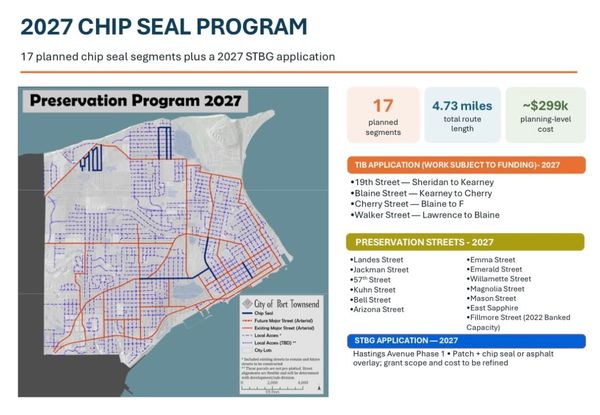
Following the consent agenda, the council held a robust discussion on proposed striping changes for Sheridan and San Juan streets, presented by the city’s engineering team. The proposals were prompted by recent chip seal projects that had erased existing pavement markings.
Staff presented three options for a dangerous stretch of Sheridan between 10th and 15th Streets—a corridor identified as a high-priority ADA route and a key connection to Salish Elementary School. The lack of sidewalks in this area has made it a “stressful place” for pedestrians and cyclists, according to Assistant City Engineer Jeff Kostechka. Option 2, which would create a “complete street” with bike lanes and a striped pedestrian lane, garnered overwhelming support from public comment and a 100% approval rating from an online survey of residents in the affected area. Councilmembers backed the safety improvements, and staff will return with a final decision on August 17.

Water rights debate: A tale of misunderstanding and good intentions
The most contentious and confusing item of the evening was the council’s review of the Jefferson County Coordinated Water System Plan (CWSP) update. This document had not been revised since 1997. The discussion became so heated and muddled that it exposed a significant gap between staff’s intentions and public perception, prompting an unusual series of motions.
The source of the confusion
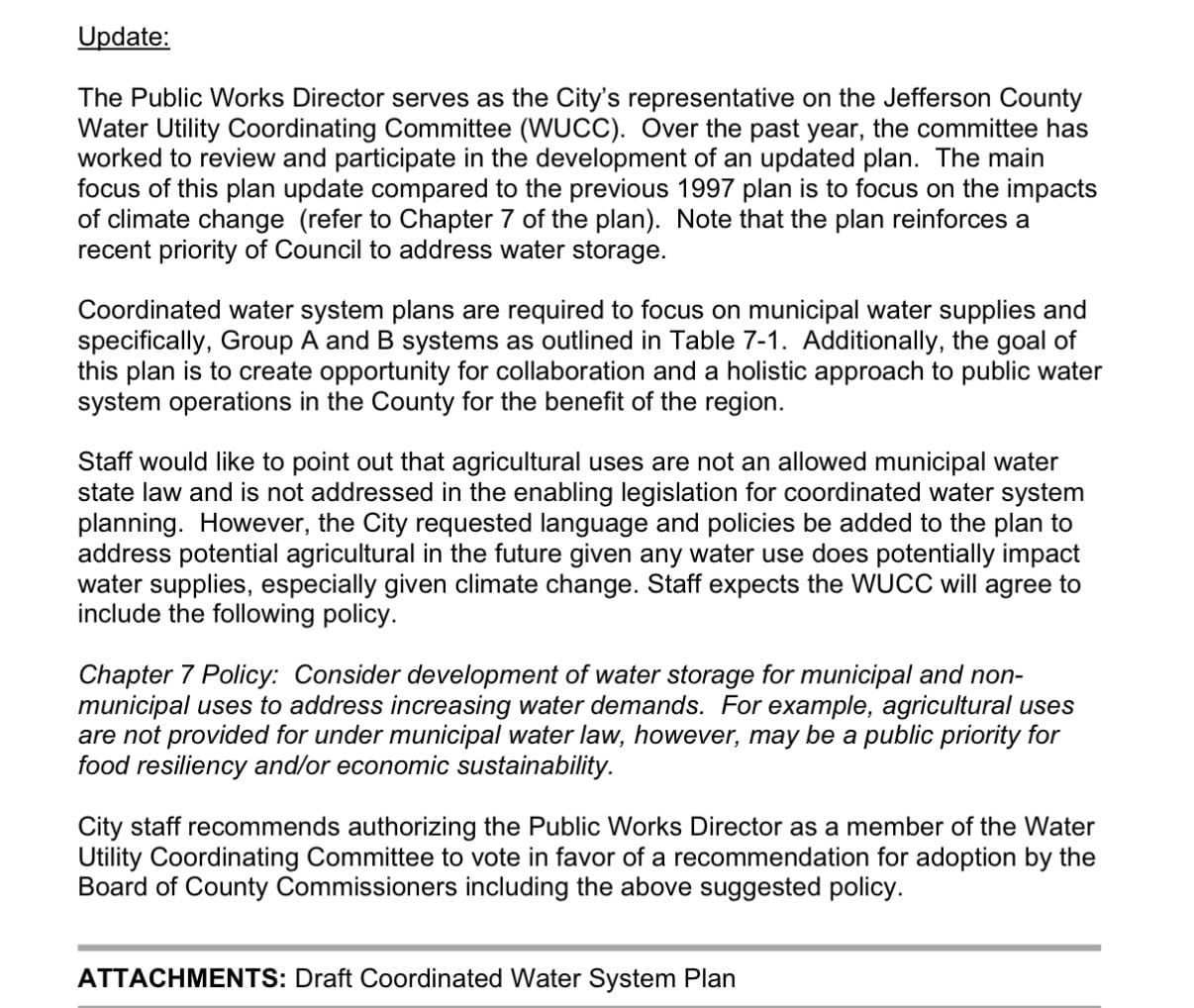
At issue was a recommendation from city staff, led by Public Works Director Steve King, for council to approve King’s participation in the county’s updated plan with proposed amendments. King explained that the CWSP typically focuses only on municipal water supplies and does not address agricultural irrigation. However, based on extensive community feedback—including a clear priority from the council’s own strategic retreat—King sought to add language that would explicitly include agricultural water use in the county’s long-term planning.
“I suggested to the committee that, as a matter of long-term planning, let’s at least create some policy that would support investigation of how we address the water supply issues in each district,” King told the council. His goal was to ensure that agriculture—a vital part of the local food system—would not be overlooked as the county plans for climate change and diminishing summer water supplies.
Public confusion and engagement
However, the language in the agenda bill and the county plan itself caused widespread confusion. A sentence in the agenda statement noted that “agricultural uses are not an allowed municipal water state law.” Several community members interpreted this as the city attempting to restrict or outlaw agricultural irrigation, spurred by robust social media speculations preceding the meeting.
Public commenters, many of whom appeared to have learned of the item at the last minute, urged the council to take no action. Long-time resident Jim Salter said he was “encouraged to hear this conversation” but wanted the council to “stand on top of this” to protect local food security. Bly Wenstrom, another resident, said the language was “extremely confusing” and asked the council to “pause and let’s get this right rather than get it back.”
The confusion was amplified by a misunderstanding of the difference between a "municipal water right" and the city’s broader water rights. Peter Schwartzman, a resident and licensed hydrogeologist, stepped forward to clarify the situation. He explained that while the city does have a municipal water right that would not allow commercial agriculture, the city also holds a 1927 water right that explicitly lists “irrigation” as a permitted use.
“Water rights don’t make any distinction between agricultural irrigation and golf course irrigation,” Schwartzman said. “Irrigation is irrigation for a water right.” He noted that he had confirmed this understanding with “someone very high up” at the Department of Ecology, who advised that an attorney should still review the city’s water rights to clarify the details.
8/05/26 Update: Since the August 3 meeting, resident Schwartzman made a correction to his public comment. The information he provided was based off of the 1927 water rights application, not the final certificate. There is no mention of irrigation as a purpose of use in the water rights application.
Council deliberation and a compromise
During council deliberation, it became clear that the staff’s intention—to include and protect agricultural water use in the county plan—had been lost in the legalistic and poorly phrased explanation. Council member Libby Wennstrom helped disentangle the issues, noting that there were three separate layers at play: the county plan itself, the need for legal clarity on water rights and the council’s immediate recommendation to the county.
Council member Fred Obee made an initial motion to postpone the decision entirely, arguing that the city needed more time to get a clear legal opinion and propose better language. “It raises significant questions that deserve more detailed answers,” Obee said. “The time allotted for community input on this issue has been insufficient.” This motion failed during discussion when council acknowledged that the Water Utility Coordinating Committee (WUCC) meeting would be voting next week, with or without a city representative vote at the table, making postponement an issue.
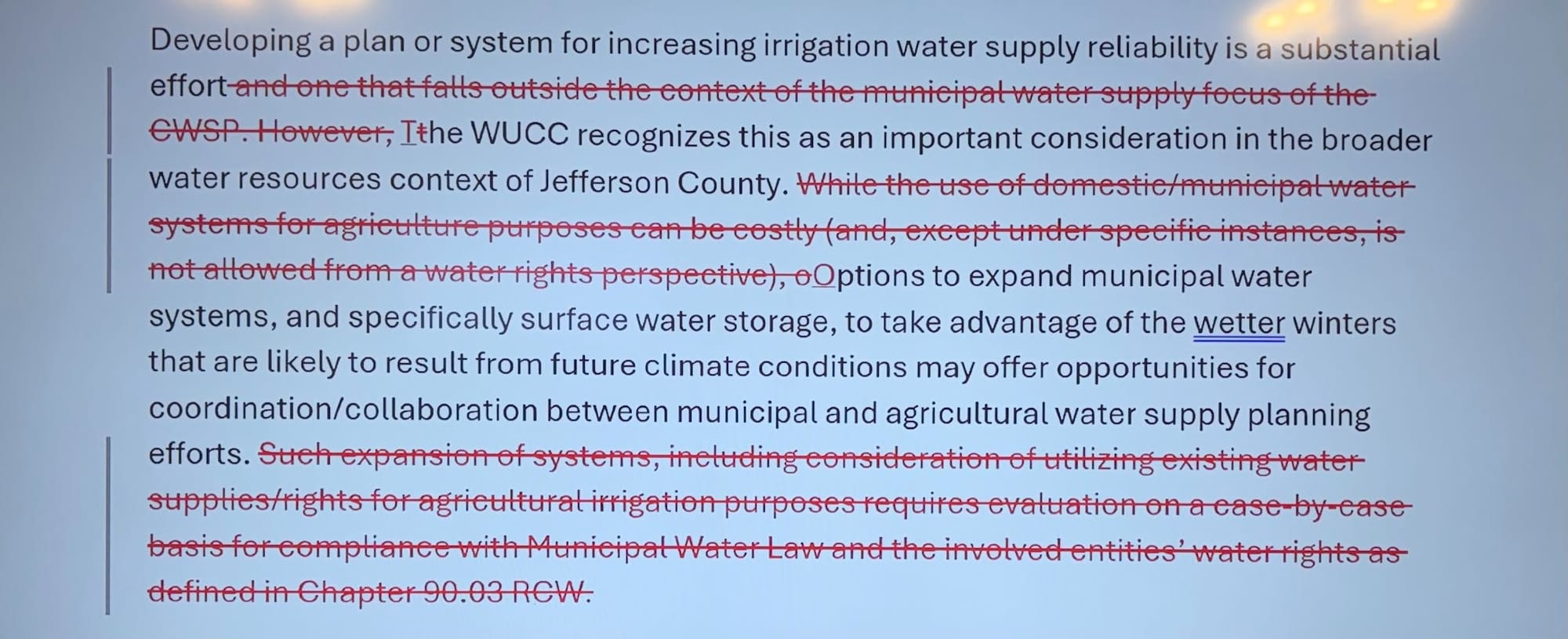
However, immediately after, a second motion was made to salvage the city’s opportunity to influence the county plan. Council members Faber and Wennstrom proposed a compromise: authorize Public Works Director Steve King to vote in favor of the plan at the upcoming WUUC meeting, but only on the condition that the controversial legal language be stricken from the actual CWSP document. The proposed edits removed the confusing parenthetical about municipal water law and replaced it with clearer language stating that the county should consider storage for both municipal and non-municipal uses, including agriculture.
Council member Monica MickHager supported the approach, noting that the county’s meeting was scheduled for the following week and that this was the city’s best chance to have a voice. “The meeting is next week. This is when this committee is going to get their recommendation. This is our opportunity. That's what I see.” MickHager said.
The compromise motion carried, ensuring that the city would not lose its opportunity to advocate for agricultural water use in the county’s planning. Council members emphasized that separate work—including hiring an outside water rights attorney to clarify the city’s legal standing—would proceed independently.
Deputy Manager decision: A strategic move for stability and economic development
The final major item of the evening was the city manager transition plan, following the announcement that City Manager John Mauro would be leaving his post after seven years of service. In a move that surprised some but was praised by all, the council approved a new leadership structure that will create a Deputy City Manager position.
An unprecedented opportunity
Cynthia Shaffer, Director of People and Performance for the City, presented four options for managing the transition. Option 2A, which the council ultimately selected, involves appointing Public Works Director Steve King as Interim City Manager. More significantly, it calls for creating a permanent Deputy City Manager role—a position that King would transition into once a new, permanent City Manager is hired. King was ultimately appointed when no other internal staff expressed interest in the role, which would have resulted in a different selection process.
King addressed the council directly, acknowledging the unusual nature of the discussion but expressing his commitment to serving the community. He noted that he is in a unique position to help the city through the transition, given his long tenure and institutional knowledge. However, he stressed that he does not wish to do two jobs at once and that the city must move quickly to backfill his current position.
“We don’t know what a council down the road will want; we don’t know what a new city manager down the road will want,” King said. “I’m entering into this as an opportunity to serve the community. I don’t want to try to do two jobs because I wouldn’t do either one well, and that would be a disservice to the community.”
Why option 2A won support
Councilmembers rallied around Option 2A for several reasons, many of which tied directly to broader strategic goals. Councilmember David Faber argued that this option “preserves maximal flexibility” and does not effectively force King into retirement. “I would be remiss to lose your institutional knowledge and skill set,” Faber told King.
Deputy Mayor Owen Rowe connected the decision to the council’s recent work session, where members identified housing and economic development as top priorities. “I’ll remind people that at our work session, the number two priority was a recommendation for an additional FTE [full-time employee] to focus on housing and economic development,” Rowe said. “So here’s that additional FTE.” Other members noted that creating a deputy position would allow for better succession planning and provide a clear career path for other junior staff, strengthening the entire organization.
Councilmember Neil Nelson, who admitted he “did not expect to come here promoting creating another full-time position,” ultimately voted in favor, stating that the move would “alleviate the need for consultants and job searches down the road.”
The motion passed unanimously, and the council directed staff to bring back a job description and salary schedule for the new deputy city manager position. Before the meeting adjourned, the council took a moment to thank City Manager John Mauro for his seven years of service, with Deputy Mayor Owen Rowe noting that Mauro’s ability to recruit and engage a talented staff made the transition “much less daunting” and “actually feel very comfortable.”