Where Does Our Stuff Go? Tracing Jefferson County's Recycling Stream
We sift through the shifts in our local recycling and food waste system.

When a Jefferson County resident tosses a bottle, cardboard box or a dead battery into a recycling bin, what happens next depends heavily on which bin it landed in. According to Justin Miskell, the county's solid waste operations manager, developing that path pits geography, contamination and the economics of hauling material off a peninsula with only two ways out.
Jefferson County started implementing a new recycling collection system last month. The switch to curbside collection for all households was made largely to reduce contamination and preserve recycling as viable at all.
Under the old system, unmanned drop-box recycling sites saw such high contamination—garbage dumped in with recyclables—that much of the material never got diverted at all.
“So much of the material that wasn't being diverted from the landfill ended up in the landfill,” Miskell said.
That system cost the county roughly $350,000 a year, subsidized by the general trashtipping fee. Jefferson was the last county in the state still doing it that way.
At the transfer station’s staffed recycling drop off, glass, plastic and oil all follow separate paths once they leave the county—so mixing them creates costly problems downstream. Plastic mixed into a glass bin fouls the machinery that washes and sorts glass at the receiving facility. Oil contaminated with gasoline forces an entire storage tank to be shut down, tested and hauled by a special truck.
“These materials need to stay with these materials,” Miskell said.
Where the commodities travel
For material that stays clean, distance is the next obstacle. Glass, the heaviest recyclable commodity, now travels to Oregon for processing. Seattle's last receiving facilities have closed, and Miskell predicts the destination will keep shifting toward California.
At a certain point, he said, the fuel burned hauling glass that far outweighs any environmental benefit of recycling it. Lighter materials like plastic face the opposite problem: too little weight per truckload to justify the trip economically.
Cardboard is the exception, and Miskell called it the county's most “responsible” commodity because it goes directly to the Port Townsend Paper Company rather than leaving the peninsula.
Should the mill close, Miskell said replacing that destination would be a major and costly problem, since cardboard is too light to economically bail and truck long distances in volume.
Batteries take the most expensive route of all, at a heavy cost to the county: about $5 per pound to dispose of and the leading cause of fires at the transfer station. Local businesses can route them through the Battery Network, a nationwide takeback program.
“Local businesses can request and receive a box and an account for no charge with a fireliner in which to collect batteries from customers for power tools and other items they sell,” Miskell said.
“The business then boxes them up, takes them to the post office and they're shipped out for free.”
A statewide overhaul aims to fix the patchwork
Jefferson county's recycling challenges mirror those of counties across the state, prompting a change in state legislation. The recycling reform act, signed in May 2025, will roll out in the next few years, and rests on a policy called Extended Producer Responsibility (EPR). Instead of residents and local governments paying to manage recyclables, the companies that make the packaging and paper products will foot the bill for its end–of-life handling.
Producers will be required to join a registered organization which will collect fees based on the volume and recyclability of the packaging they put into the Washington market, with higher fees charged for less-recycled materials.
The actual applicability of the law tends to be lower for small population counties, and it is not yet completely mapped out.
“Because we have unique rural logistics and limited processing facility capacities in comparison to densely populated counties, the enforcement timing for specific curbside mandates and other thresholds depends on the Department of Ecology's annual mapping updates and local solid waste management planning integration,” Miskell said.
A home grown approach to food waste
Food waste is generated daily by virtually all of us, and presents somewhat different problems and opportunities.
The opportunity to compost food waste is available to many of us, though it entails time, a learning curve and some consistent monitoring. Approximately 24% of municipal garbage waste in Jefferson County is food waste, a staggering 11.5 million pounds.
This problem posed an opportunity for Jefferson County resident and former mushroom farmer Keith Dixon.
Dixon created Return to Earth (RTE), a small composting service about two-and-a-half years into operation, and roughly seven weeks into offering the county's first residential food-scrap subscription service.
“Composting food waste with Return to Earth is an investment in the health and wellbeing of our environment and community,” Dixon said.
RTE has signed up 85 residential subscribers so far, with a goal of 200 by the end of the year. They recently added their first commercial account, collecting a dozen 45-gallon carts of fish scraps weekly from a local restaurant.
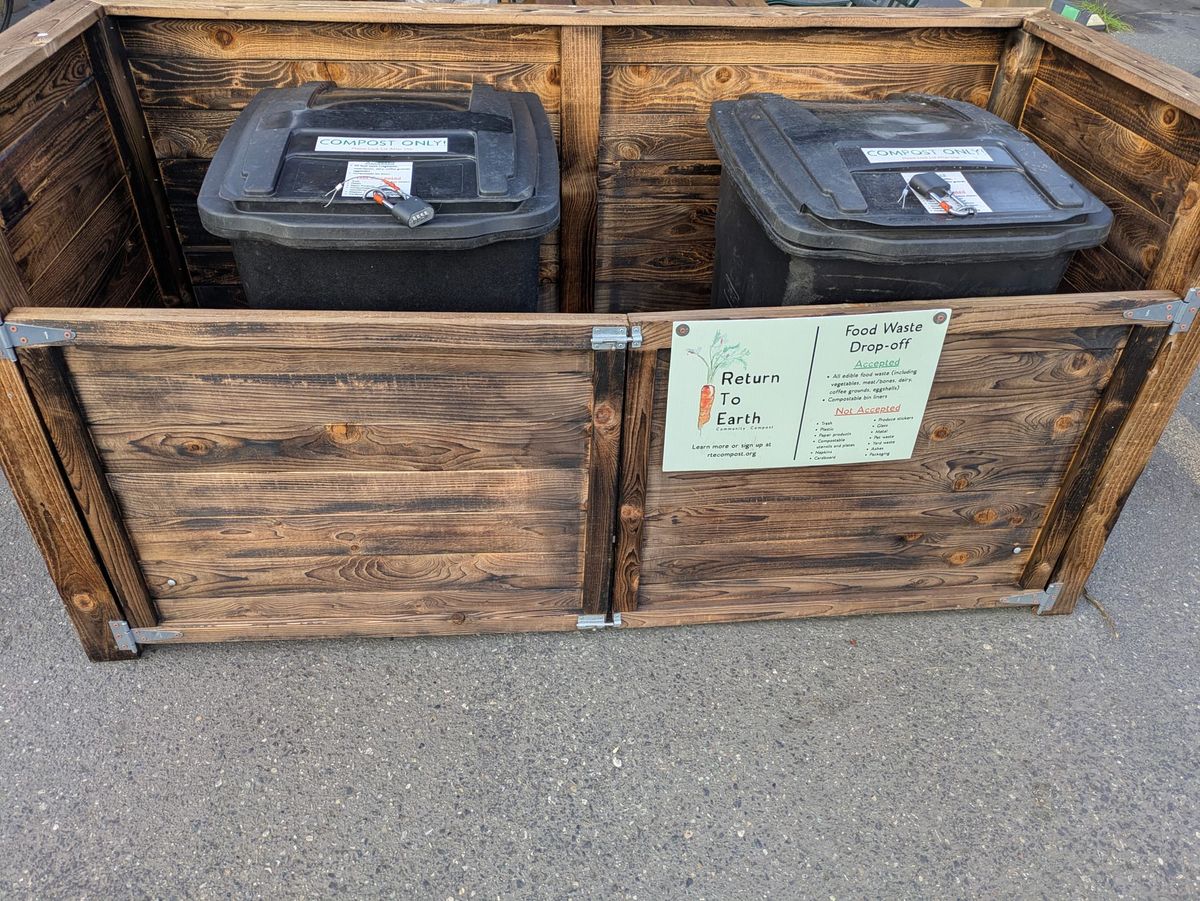
Subscribers may drop off their food waste at four locations in Port Townsend into bins with a combination lock. Dixon hopes to place boxes elsewhere in the county, such as Cape George and Kala Point in the next six months.
The food waste is picked up from these boxes, transported to a site at the county’s solid waste facility that Dixon has rented out for a low rate. It is then collected into piles that are managed for four months as they transform into usable compost. The compost is then sold to the public in both bagged and bulk form. RTE subscribers will get a free bag every six months.
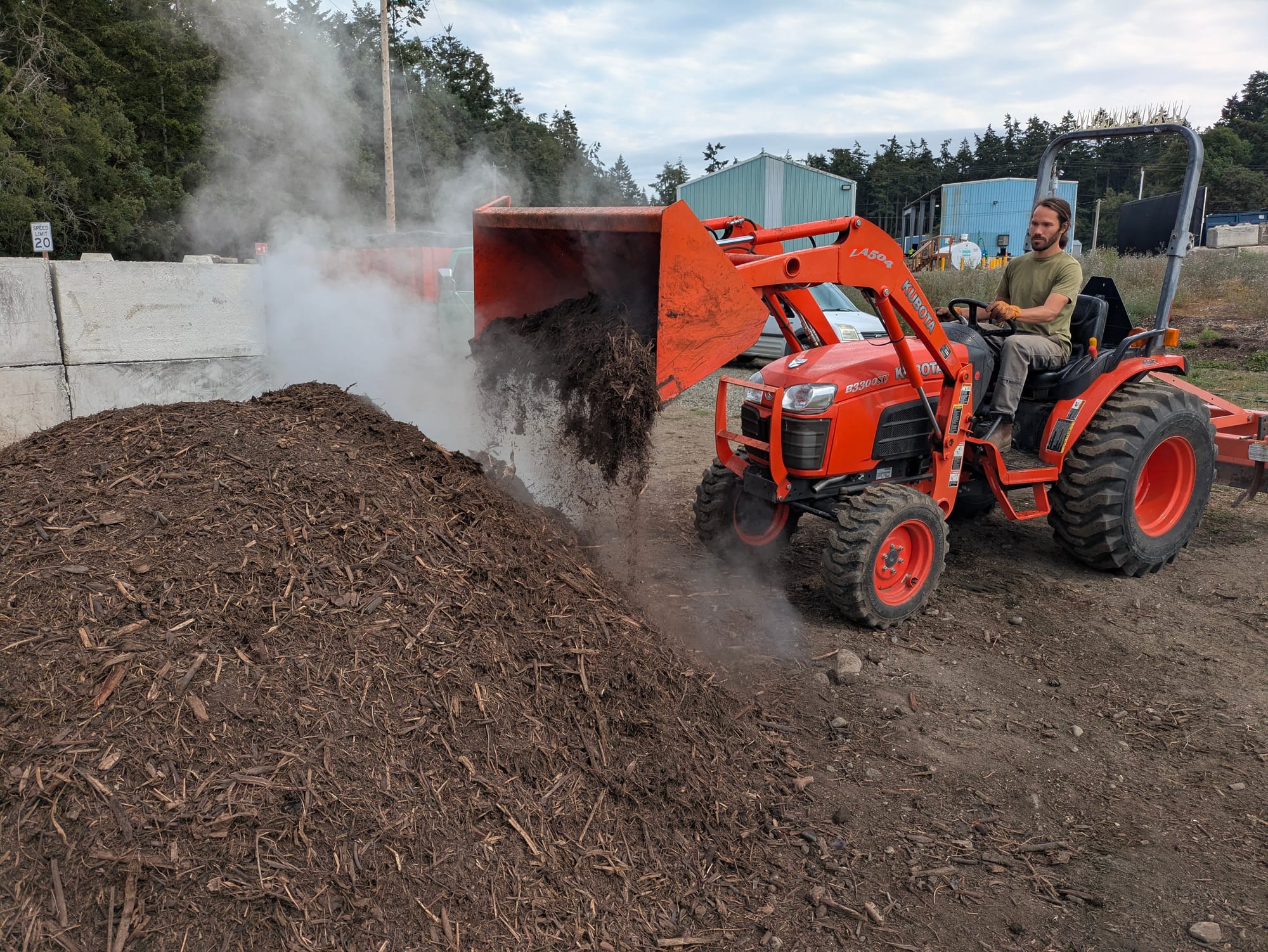
Dixon received a Washington State Department of Ecology grant that currently covers outreach, education, and a free collection service for the Chimacum School District, which alone has diverted an estimated 5,000 pounds of cafeteria food waste. Material is processed on-site using an aerated static pile system—roughly a month of active composting followed by two more months of curing—before being screened and sold back to the community or returned to subscribers as finished compost.
Dixon credits Jefferson County Solid Waste Program Manager Al Cairns with pushing the roughly 15-month land-lease approval through the county. Cairns called the arrangement—cheap land in exchange for diverting material the county would otherwise have to landfill—closely aligned with the county's own solid waste goals. Dixon notes that food scraps in landfills are a large source of U.S. methane.
Education is a big component of Dixon’s endeavor.
“It’s an investment that has immediate returns; nutrients stay in our local soils, less garbage gets trucked far away to the dump, and our community web is strengthened through supporting a nonprofit,” Dixon says.
“Getting people to understand the cost of throwing food in the trash when we can compost. It’s pretty low hanging fruit.”
Learn more about Return to Earth at https://www.rtecompost.org